
Overheating is one of the most overlooked risks in electrical enclosure design. Power supplies, circuit breakers, transformers, drives, and other electronic components generate heat during operation. When this heat cannot escape efficiently, internal temperatures can exceed component limits, resulting in shorter service life, unexpected shutdowns, and higher maintenance costs.
For OEM equipment manufacturers, choosing the right enclosure is only part of the solution. Ventilation layout, material selection, mounting arrangements, and environmental protection must work together. Xiamen Huapusheng Sheet Metal Manufacturing Co., Ltd. (HPS), a precision sheet metal manufacturer established in 2003, provides customized enclosure fabrication and assembly solutions for power distribution, industrial equipment, and new energy applications.
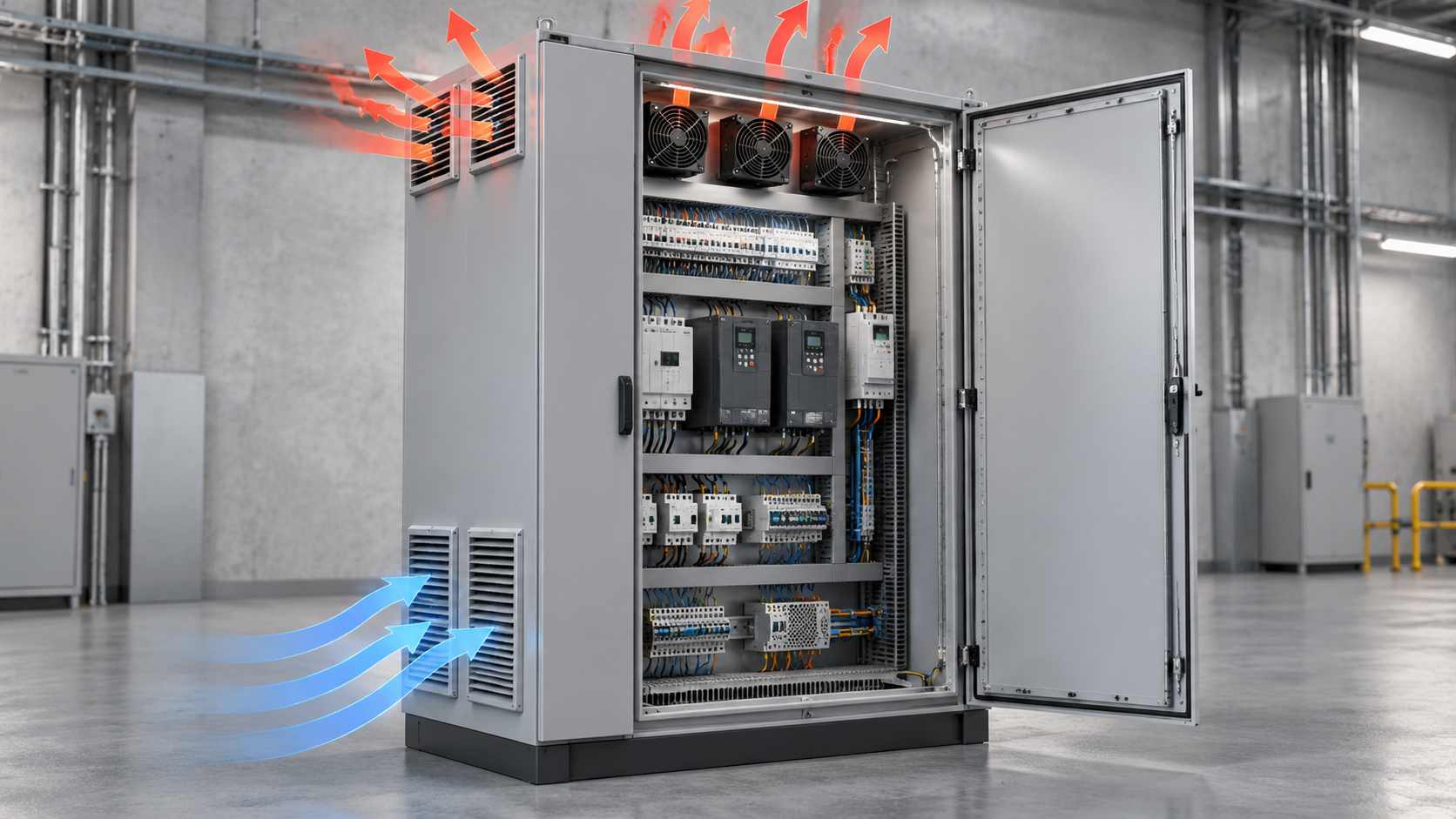
To prevent overheating in an electrical enclosure, first calculate the total heat generated by internal components. Then determine the allowable temperature rise, evaluate natural or forced ventilation, and select an appropriate cooling method. Ventilation openings must also be designed around the required IP protection level, operating environment, and equipment layout.
A well-designed enclosure should provide sufficient heat dissipation without compromising dust protection, moisture resistance, structural strength, or maintenance accessibility.
Electrical enclosures are designed to protect sensitive components, but their enclosed structure can also restrict heat dissipation. Several factors contribute to excessive internal temperatures.
Almost every electrical component produces some heat during operation. However, the amount varies depending on its efficiency, operating load, and working conditions.
For an accurate thermal assessment, engineers should use manufacturer-specified power losses rather than assuming that the rated electrical input power becomes heat inside the enclosure.
Even when the total heat generation is relatively low, poor internal arrangements can create localized hot spots. Components installed too close together, blocked ventilation paths, and poorly positioned fans can prevent heated air from leaving the enclosure.
External conditions also matter. A cabinet installed outdoors in direct sunlight or inside a poorly ventilated equipment room may experience much higher thermal loads than the same cabinet operating in a temperature-controlled environment.
Before choosing a fan or air conditioning unit, engineers should estimate the heat that needs to be removed.
Add the heat losses of all major electrical components operating under the expected load conditions.
Example: Consider an industrial control cabinet containing the following equipment:
| Component | Estimated Heat Loss |
|---|---|
| Power supply units | 120 W |
| Variable frequency drives | 300 W |
| Control and communication modules | 60 W |
| Circuit breakers and other components | 120 W |
| Total | 600 W |
These figures are illustrative. Actual values should be obtained from equipment datasheets and adjusted for the expected operating conditions.
For a preliminary forced-air cooling estimate, the required airflow can be calculated using:
Q ≈ 3 × P / ΔT
Where:
For a cabinet generating 600 W of heat, assuming a 10°C temperature rise:
Q ≈ 3 × 600 / 10 = 180 m³/h
This is an idealized estimate based on typical air properties. Actual fan selection must account for filter resistance, pressure losses, installation restrictions, air recirculation, altitude, and the fan's performance curve. It is not a substitute for a complete thermal design or temperature-rise test.
Different components have different operating temperature limits. The acceptable enclosure temperature should therefore be determined by the most temperature-sensitive equipment, considering the manufacturer's specified ambient and operating conditions.
Engineers should also consider temperature variations between the top, middle, and bottom of the cabinet. A single temperature measurement may not reveal localized overheating.
Not every electrical cabinet requires an active cooling system. The right choice depends on heat generation, ambient temperature, contamination risks, and the required protection level.
| Cooling Method | Main Advantages | Limitations | Typical Application |
|---|---|---|---|
| Natural Ventilation | Low cost, no fan power required | Limited cooling capacity | Low-power control cabinets |
| Forced-Air Cooling | Higher airflow and controllable ventilation | Requires filter maintenance | Industrial control equipment |
| Air Conditioning | Can cool below ambient temperature | Higher initial and operating costs | High-heat-density cabinets |
| Heat Exchanger | Separates internal and external airflows | Depends on external cooling conditions | Dust-sensitive industrial systems |
For many industrial applications, forced-air cooling offers a practical balance between cooling performance and cost. However, environments containing conductive dust, corrosive substances, or moisture may require a sealed cooling solution instead.
Ventilation openings improve heat exchange, but they also create potential entry points for dust, water, and other contaminants. This is particularly important for electrical enclosures installed outdoors or in industrial environments.
Ventilation panels should provide sufficient effective airflow area while maintaining mechanical strength and the required protection level. Simply increasing the number of holes does not guarantee better cooling.
Engineers should consider opening geometry, airflow direction, filter arrangement, drainage, and the possibility of direct water exposure.
For projects requiring customized airflow openings, HPS can support the production of Custom Sheet Metal Rackmount Enclosures with project-specific fabrication and finishing requirements.
The IEC 60529 standard classifies enclosure protection against access to hazardous parts, solid foreign objects, and water. The appropriate IP rating depends on the actual installation environment.
For example, IP54 provides protection against harmful dust ingress and water splashing from any direction, while IP65 provides dust-tight protection and resistance to water jets under specified test conditions.
Adding an unprotected ventilation opening can invalidate the intended protection performance of an enclosure. Filtered vents, sealed fan assemblies, and properly designed air-conditioning systems should be evaluated as part of the complete enclosure design.
When selecting Custom Industrial Metal Enclosures, buyers should specify the required IP rating, installation location, and cooling arrangement before manufacturing begins.
Thermal management is not determined by fans and cooling equipment alone. The enclosure's physical construction also affects how effectively heat can be managed.
Steel, stainless steel, and aluminum have different thermal conductivity, strength, and corrosion-resistance characteristics. Aluminum generally transfers heat more readily than common carbon steel, but the overall cooling performance also depends on enclosure geometry, surface area, airflow, and external conditions.
Panel thickness should be selected according to structural requirements, equipment weight, vibration, and manufacturing considerations rather than thermal conductivity alone.
Leave sufficient clearance around heat-generating components and avoid placing ventilation openings where internal wiring or mounting plates block airflow. Hot air should have a clear route toward the exhaust area.
For complex OEM projects, Custom Sheet Metal Enclosure Fabrication should consider cutting, punching, bending, welding, surface treatment, and final assembly as connected manufacturing stages.
This is where early cooperation between equipment designers and sheet metal manufacturers becomes valuable. Changes to ventilation openings, mounting brackets, or panel geometry are generally easier to incorporate before production tooling and assembly procedures are finalized.
Consider an illustrative OEM project involving a 600 W internal heat load. The cabinet is installed in an industrial room with an ambient temperature of 30°C. The engineering team wants to maintain the cooling air temperature rise within approximately 10°C.
The preliminary airflow calculation indicates a requirement of approximately 180 m³/h under ideal conditions.
Before approving the final design, the engineering team should complete the following checks:
| Design Check | Required Action |
|---|---|
| Heat Load | Verify actual component heat losses. |
| Airflow | Select a fan based on its operating point and system resistance. |
| Ventilation | Check inlet and exhaust positions for unobstructed airflow. |
| Protection | Verify the complete assembly meets the required IP rating. |
| Validation | Measure internal temperatures under representative operating conditions. |
The final fan capacity may need to exceed the theoretical airflow requirement because filters, grilles, and internal obstructions reduce actual airflow. If the ambient temperature approaches or exceeds the required internal operating temperature, a fan-only solution may also be insufficient.
For this type of project, the enclosure manufacturer needs to coordinate the cabinet dimensions, ventilation openings, component mounting structure, and finishing requirements with the OEM engineering team.
Founded in 2003, Xiamen Huapusheng Sheet Metal Manufacturing Co., Ltd. (HPS) specializes in precision sheet metal fabrication for electrical equipment, power control systems, industrial enclosures, and new energy applications.
HPS operates a 30,000 m² manufacturing facility in Xiamen, China, with more than 200 employees, including 36 R&D and technical personnel. The company holds ISO 9001, ISO 14001, ISO 45001, and IATF 16949:2016 certifications.
Its manufacturing capabilities cover the major processes required for customized enclosure production:
For OEM buyers, this integrated production capability helps coordinate design requirements with fabrication and assembly. Instead of treating the enclosure as a simple metal box, HPS works with project-specific drawings and technical requirements to manufacture components suited to their intended applications.
When developing a new electrical cabinet, customers can provide drawings, 3D files, material requirements, expected heat loads, and target IP ratings for engineering evaluation.
The most common causes include excessive internal heat generation, insufficient airflow, high ambient temperatures, blocked ventilation openings, and poor component arrangement. Incorrectly selected cooling equipment can also contribute to overheating.
First, calculate the total heat loss of all internal components. Then estimate the required airflow using the heat load and allowable temperature rise. Finally, select a fan based on its performance curve and the actual pressure losses caused by filters, grilles, and internal restrictions.
Yes, but conventional open ventilation holes cannot automatically maintain IP65 protection. A properly engineered solution, such as a sealed cooling system or an appropriately tested filtered ventilation assembly, is necessary. The completed enclosure must be verified against the required protection standard.
Steel is commonly selected for its strength, rigidity, and cost-effectiveness. Aluminum offers lower weight and higher thermal conductivity. The final choice depends on structural requirements, corrosion exposure, weight restrictions, heat dissipation, and total project cost.
Prepare the enclosure dimensions, 2D drawings or 3D models, material and thickness requirements, component layout, estimated heat generation, ventilation requirements, IP rating, surface finish, and expected production quantity. These details help the manufacturer evaluate feasibility and provide a more accurate quotation.
Yes. Xiamen Huapusheng Sheet Metal Manufacturing Co., Ltd. provides customized sheet metal fabrication, enclosure manufacturing, welding, surface treatment, and assembly services. HPS supports OEM projects requiring customized dimensions, structures, materials, and finishing specifications.
 Get a Quote Now


 IPv6 Network Supported
Leave A Message
Scan to Wechat :

Scan to Whatsapp :

Hi! Click one of our members below to chat on

 English
 Français
 Deutsch
 Русский
 Italiano
 Español
 Nederland
 日语
 한국어
 Svenska