

You select a China Sheet Metal Fabrication partner by verifying process capability, including precise Sheet Metal Finishing Screen Printing, quality certifications, engineering support, and communication before you discuss price. A wrong choice costs you rework, tooling loss, delays, and IP risks. In 2026, rising domestic demand and stricter quality expectations demand extra diligence. An OEM-grade factory owns its processes and engineers; a trading company does not.
Check the factory's equipment and certifications first. This step ensures they can meet your quality needs.
Ask for design help early. This action reduces costly mistakes and saves time.
Start with a small test order. This approach confirms the factory's abilities before you commit to a large production run.
When you evaluate a China Sheet Metal Fabrication partner, four factors determine whether the relationship succeeds or fails. Each factor reveals the factory's true capability beyond marketing claims.
You must verify the factory's equipment before you discuss price. The machines on the shop floor dictate the tolerances, materials, and volumes the factory can deliver. For CNC punching, the parameters below represent the standard capability you should expect from a qualified OEM-grade manufacturer:
|
Parameter |
Specification |
|---|---|
|
Material Thickness |
0.5 mm – 10 mm |
|
Materials Supported |
Aluminum, Stainless Steel, Mild Steel, Copper |
|
Hole Shapes |
Round, square, rectangular, slotted, custom |
|
Max Sheet Size |
Up to 1250 mm × 2500 mm (varies by press) |
|
Tolerance |
±0.05 mm (typical) |
|
Production Volume |
Low-volume prototyping to mass production |
Standard manual or mechanical punches typically handle sheet metal up to 3–6 mm thick, depending on punch size and material hardness. Hydraulic and CNC punch presses can handle up to 10 mm or more with appropriate tooling. For tight tolerances and repetitive operations, CNC-compatible hardened steel dies are essential. You must ensure punch and die clearance matches material thickness to prevent tool wear and deformation.
A factory that maintains its equipment delivers consistent quality. Expect a qualified manufacturer to follow these practices:
Inspect and sharpen punch tools after every 5,000–20,000 hits, depending on material hardness and usage frequency
Perform regular lubrication on all moving components
Conduct alignment checks on a scheduled basis
Inspect die wear regularly to extend tool life and ensure precision
HPS operates advanced CNC punching, laser cutting, bending, and welding equipment that meets these specifications across all production stages.
Certifications separate a legitimate OEM manufacturer from a general job shop. Each industry demands specific certifications, and you must verify that your supplier holds the correct ones for your product. The table below maps industry requirements:
|
Industry |
Baseline Certification |
Additional Requirement |
|---|---|---|
|
General OEM |
ISO 9001:2015 |
FAI / Cpk data on request |
|
Automotive |
IATF 16949 |
PPAP documentation |
|
Aerospace / Defense |
AS9100D |
Material traceability, ITAR awareness |
|
Medical Devices |
ISO 13485 |
Cleanliness and surface roughness control |
ISO 9001:2015 is the baseline; industry-specific certifications (IATF 16949, AS9100D, ISO 13485) signal a supplier built for regulated OEM work.
Beyond industry-specific certifications, you need to understand the broader compliance landscape. The following table lists certifications that govern market access:
|
Certification |
Scope |
Relevance to OEM Sourcing |
|---|---|---|
|
ISO 9001:2015 |
Quality Management Systems |
Mandatory baseline for all industrial suppliers |
|
ISO 14001:2015 |
Environmental Management |
Required for EU and corporate sustainability compliance |
|
ISO 45001:2018 |
Occupational Health & Safety |
Critical for audit compliance in high-risk environments |
|
CE Marking |
EU Conformity (Machinery, EMC, LVD) |
Required for products sold in the European Economic Area |
|
UL Recognition |
Safety of Components/Systems |
Essential for electrical enclosures and panels (e.g., UL 50, UL 508A) |
|
FDA 21 CFR Part 820 |
Quality System Regulation |
Required for medical-grade sheet metal components |
|
AS9100D |
Aerospace Quality Management |
For aerospace and defense supply chains |
|
RoHS / REACH |
Hazardous Substance Compliance |
Required for electronics and EU markets |
When you evaluate certifications, follow this practical advice:
ISO 9001 certification is common among established fabricators and covers process controls, corrective action procedures, and supplier qualification. Request a current certificate and verify the scope matches your requirements.
For automotive work, IATF 16949 compliance is available from larger, more specialized suppliers. Ask whether the supplier can support First Article Inspection (FAI) reports and GD&T-annotated CMM outputs.
For medical device work, ensure fabricators align their processes to ISO 13485 requirements.
Ask for certification documentation before committing. Verify quality through documented processes rather than marketing language.
HPS holds ISO 9001:2015 certification and supports IATF 16949-aligned processes for automotive clients, with full documentation capabilities for export markets.
Design for Manufacturing (DFM) support directly reduces your rework rates and production costs. A manufacturer that offers DFM analysis during the quoting phase prevents problems before they reach the shop floor. The table below shows how specific DFM rules reduce rework:
|
DFM Design Rule |
How It Reduces Rework |
Quantified Impact |
|---|---|---|
|
Design weld joints for accessibility |
Joints a welder cannot comfortably reach require specialized fixturing and slower travel speeds |
Higher rework rates when accessibility is ignored |
|
Explicitly specify masking requirements on drawings |
Unspecified masking discovered during production causes rework and delay |
Prevents rework and delay from late-discovered masking needs |
|
Maintain safe hole-to-bend distance (e.g., 3.0mm vs 0.5mm on 1.0mm stainless) |
Holes too close to bend lines deform during forming, requiring scrap or rework |
Scrap can reach 5–15% of total production cost on complex parts |
|
Add bend reliefs to flat patterns |
Omitting relief causes corner tearing that can scrap the part |
Prevents up to 400 potential defect locations on a 100-part run with 4 corners each |
|
Apply DFM principles early in design |
Early implementation reduces material waste and production mistakes |
~18% reduction in material waste; production mistakes cut by nearly a quarter |
DFM reduces costs by aligning your design decisions with real-world manufacturing capabilities. It minimizes material waste, eliminates custom tooling, shortens setup time, and simplifies assembly. Common design mistakes that increase fabrication costs include:
Unnecessarily tight tolerances on non-critical features
Non-standard bend radii or hole sizes requiring custom tooling
Parts that waste material or nest inefficiently
Assemblies needing complex fixtures or lacking alignment features
Overlooked access for inspection, fastening, or welding
DFM improves quality by designing parts that are easier to produce consistently. Standard tooling, stable forming processes, manufacturable tolerances, and self-locating assembly features all reduce variation. Designs aligned with standard manufacturing processes reduce setups, eliminate special-order materials, improve flow across cutting-forming-welding-finishing stages, and prevent rework. HPS provides DFM feedback on every quotation, helping you optimize your designs before production begins.
Industry practitioners managing supply chains between Asia, Europe, and the United States describe the certification landscape for sheet metal fabrication exports as layered. Some standards serve as universal baselines, others act as region-specific gates, and a few unlock the highest-margin defense and aerospace work. Producing good parts is only half the battle. Proving compliance through the right certifications is what actually gets sheet metal fabrication across borders. A real-world example: a US client's order of custom mounting brackets from Vietnam stalled at customs because the supplier lacked proper RoHS and REACH declarations, costing weeks of delay and thousands of dollars.
The table below maps the certifications you need for specific market access:
|
Certification / Standard |
Purpose / Market Access |
|---|---|
|
ISO 9001 |
Baseline quality management system |
|
CE marking |
EU market access |
|
UL certification |
US electrical enclosures |
|
RoHS & REACH declarations |
Customs compliance for EU/US entry |
|
ITAR compliance |
Defense sector access |
|
AS9100D |
Aerospace sector access |
|
IATF 16949 |
Automotive sector access |
A robust quality management system includes these essential elements:
Defect prevention as a core principle
Continual improvement processes
Waste reduction
Material traceability from source to finished part
In-line QC at every workstation
PPAP-ready documentation before shipping
Systematic process assessment and manufacturing process control (VDA 6.3)
Structured stages: specification, material traceability, cutting and crimping, assembly, in-line QC, final documentation
Quality is more than meeting specifications. It is about having the right systems, processes, and discipline in place to deliver consistent and reliable results. Our commitment to quality is supported by internationally recognized standards and structured quality management practices, including IATF 16949 for automotive-related manufacturing, ISO 9001 for systematic quality management and continuous improvement, VDA 6.3 for systematic process assessment and manufacturing process control, and UL 157 for applicable safety requirements. For our customers, this means greater confidence in process consistency, product quality, reliability, and long-term supply.
HPS implements these quality management practices across every production line, ensuring your parts meet export requirements without customs delays.
A factory's true capability emerges when you verify its control over each production step. You need to understand which processes happen in-house and which rely on external vendors. HPS maintains full in-house control over cutting, bending, welding, and finishing to guarantee consistent quality.
In-house control gives you direct accountability. When a factory outsources critical processes, quality becomes harder to trace, and lead times increase. You should prioritize suppliers that own their core manufacturing steps rather than acting as assembly coordinators.
Precision begins with the machine tool. For laser cutting, you can expect these typical tolerances:
|
Process |
Feature |
Tolerance Range |
|---|---|---|
|
Laser Cutting |
Linear Dimension (<100mm) |
±0.05 to ±0.1 mm |
|
Laser Cutting |
Linear Dimension (>100mm) |
±0.1 to ±0.5 mm |
|
Laser Cutting |
Hole Diameter (<5mm) |
±0.05 to ±0.1 mm |
|
Laser Cutting |
Hole Diameter (>5mm) |
±0.1 to ±0.15 mm |
|
Bending |
Angle Tolerance |
±0.5° to ±1.0° |
|
Bending |
Linear Dimension (Post-Bend) |
±0.3 to ±0.8 mm |
Material thickness affects these values. Thin materials allow tighter tolerances. You should request capability data for your specific material and thickness before committing to a supplier.
Welding defects can compromise part integrity. Common issues include:
|
Defect |
Root Causes |
Countermeasures |
|---|---|---|
|
Burn-through |
Excess heat input, thin section |
Reduce heat, increase travel speed, use backing bar |
|
Porosity |
Contaminants, moisture |
Clean surfaces, improve gas coverage |
|
Lack of fusion |
Low heat input, bad fit-up |
Increase energy, correct joint preparation |
|
Cracking |
High restraint, hydrogen |
Pre-heat, stress relief, low-hydrogen consumables |
Surface finishing requires similar control. You should verify that the factory documents every finishing step and inspects for defects before shipment.
The best China Sheet Metal Fabrication partners can transition smoothly from prototype to full production. Prototype runs reveal design issues and verify tooling. Pilot runs validate repeatability across your target volume. You need a supplier that holds tolerances across thousands of units, not just the first few. HPS transitions from prototype to high-volume production without renegotiating tolerances or introducing new variables.
You must stop non-conforming material before it reaches production. A qualified China Sheet Metal Fabrication partner verifies every incoming batch against documented requirements. Expect these checks:
Cross-check the mill test certificate (MTC) against the actual material for grade, heat number, thickness, and surface condition
Perform hardness testing (Rockwell or Brinell) on random samples from each batch
Verify chemical composition with a handheld XRF analyzer, especially for titanium and high-alloy steels
Check raw stock dimensions, flatness, and edge condition before cutting
Quarantine and return any batch that fails inspection
Inspection happens at two stages. In-process inspection detects issues early and keeps the process under control. Final inspection verifies that all specifications and requirements are met before delivery.
|
Inspection Stage |
When It Occurs |
Primary Purpose |
Key Benefit |
|---|---|---|---|
|
In-process inspection |
During fabrication |
Detect issues early and keep the process under control |
Reduces risk and improves efficiency |
|
Final inspection |
After production |
Verify all specifications and requirements are met |
Ensures higher-quality outcomes before delivery |
Your supplier should confirm no defects, verify all dimensions, and treat final inspection as the last quality checkpoint.
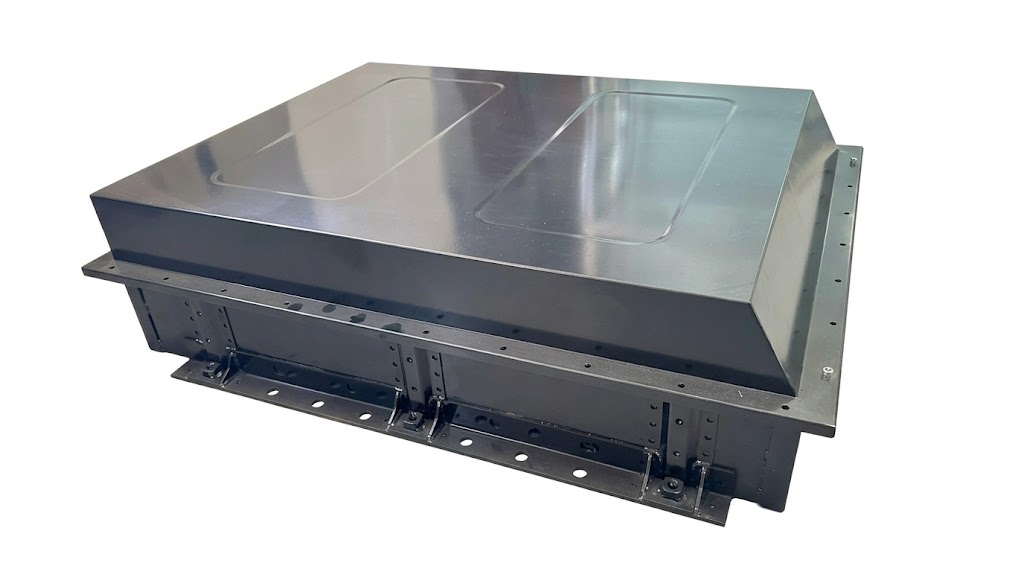
In OEM Sheet Metal Battery Box Fabrication, traceability lets you take a failed part from the field and trace it back to the specific raw material batch, machine, operator, and process settings. Every measurement, test result, and inspection action must be recorded. Certificates of Conformance, inspection reports, and calibration logs create this audit trail. When nonconformities occur, a structured method such as the 8D Report guides problem analysis, containment, root cause identification, and permanent corrective action. Supporting tools include the Ishikawa diagram and the 5 Whys method. Findings may trigger updates to the FMEA, Control Plan, or work instructions.
A First Article Inspection (FAI) verifies an initial production item against defined requirements. New parts or production changes trigger an FAI. The report records objective evidence of product conformity. Aerospace programs may use AS9102 for structured FAI documentation. Typical documents include:
First-part inspection and dimensional inspection reports
Ballooned drawings and material certifications
Certificate of Conformance
AS9102 forms and special-process certifications
Part or lot identification
You must approve the FAI before the remainder of production continues.

Your technical drawing acts as the single source of truth for your sheet metal partner. An ambiguous drawing invites interpretation errors, rework, and delays. Precision in your documentation starts with three critical areas: tolerance, material, and finish specifications.
Every dimension on your drawing requires a clear tolerance callout. The table below shows standard tolerance ranges you should specify for common sheet metal features:
|
Feature |
Standard Tolerance |
Critical Tolerance |
|---|---|---|
|
Cut profile dimensions |
±0.2 mm |
±0.05 mm |
|
Bend-to-hole position |
±0.3 mm |
±0.1 mm |
|
Bend angle |
±1.0° |
±0.5° |
|
Flatness (per 300 mm) |
±0.5 mm |
±0.2 mm |
You must specify the exact material grade, thickness tolerance, and temper condition. Surface finish requirements belong on the drawing, not in a separate email. A clear drawing eliminates guesswork.
Cross-border RFQs fail when drawings and expectations misalign. Three misunderstandings cause most problems. First, some buyers expect the supplier to interpret "standard finish" without defining it. Second, buyers often omit weld specifications, leaving joint type and penetration depth to the factory. Third, critical-to-function dimensions rarely receive clear marking on the drawing.
A single missing tolerance on a hole diameter can turn a functional part into scrap. Document every dimension your part requires.
Ask these questions before you send your first drawing. What file format does your supplier prefer for import? Does your drawing include a revision block with change history? Have you marked critical dimensions with GD&T callouts? HPS includes these questions in every RFQ response, ensuring your technical intent transfers accurately to production. A thorough drawing saves weeks of back-and-forth communication.
Your order quantity and design complexity determine unit price. Tooling costs for bending tools, dies, and fixtures add a fixed upfront expense. These costs spread across your total volume, making high-volume orders cheaper per unit. For prototypes, tooling significantly increases price. The chart below shows how unit cost decreases as quantity increases.
Consider the following cost breakdown for a typical part:
|
Quantity |
Unit Cost (USD) |
Total Cost |
Cost vs. 1000 pcs |
|---|---|---|---|
|
5 |
$58.00 |
$290 |
+680% |
|
25 |
$32.00 |
$800 |
+290% |
|
100 |
$18.00 |
$1,800 |
+120% |
|
500 |
$10.00 |
$5,000 |
+22% |
|
1000 |
$8.20 |
$8,200 |
Baseline |
HPS provides transparent pricing with no hidden tooling charges for standard parts.
Minimum order quantities vary by supplier. As one industry source states:
Many Chinese factories set MOQs of 500 or 1,000 units... MSTFAB offers small-order fast custom fabrication starting at MOQ 20.
Typical MOQ for custom parts from China Sheet Metal Fabrication falls between 50 and 100 pieces. You can negotiate lower quantities for prototypes or repeat orders.
Standard lead times for CNC sheet metal orders range from 10 to 15 working days. Expedited service cuts that to 5 to 7 days for an additional fee.
Most OEM-grade factories require a 30% to 50% deposit with the balance due before shipment. Larger orders may allow T/T or L/C terms. Confirm terms in your purchase agreement.
Many suppliers claim to be manufacturers but operate as intermediaries. You must verify factory status before you commit. China Sheet Metal Fabrication partners that own their production lines differ sharply from trading companies. Use the following table to identify common disguises and apply practical counter-measures:
|
Disguise |
Counter-measure |
|---|---|
|
Generic 'Manufacturing Co., Ltd.' in name without actual manufacturing scope |
Always check business license scope, not company name. |
|
Stock factory photos on website |
Run reverse image search (Google Images, TinEye, Yandex). |
|
Rented factory for video call |
Call back unannounced, ask to see different corners, check wall-mounted business license, speak to line workers. |
|
Fabricated certifications (ISO, CE, etc.) |
Verify against issuing body's public registry (IAF CertSearch, EU NANDO, FDA). |
A factory that serves only domestic customers lacks the export experience you need. These suppliers often fail to provide proper documentation for customs clearance, such as RoHS or REACH declarations. Export-oriented factories understand international quality standards and shipping requirements. A direct factory like HPS has established export processes that avoid these delays.
Several warning signs during the quoting process indicate deeper problems. Watch for these behaviors:
Claiming capability in all processes without asking technical questions
Providing a quote within 30 minutes without requesting your drawings or specifications
Refusing a video call or live factory walkthrough
Pricing far below the market cluster without a credible explanation
Failing to provide past inspection reports (with customer details redacted)
Each of these signals points to a supplier that will create problems during production or shipment.
You must verify a supplier's claims before you place a production order. These steps protect your investment and confirm the factory meets your standards.
When sourcing a Customized Energy Storage Cabinet Metal Enclosure, you should request a live video tour of the production floor. Ask the supplier to show you the cutting, bending, welding, and finishing areas. A legitimate China Sheet Metal Fabrication partner will welcome this transparency. During the tour, look for active production, organized material storage, and calibrated inspection equipment. An on-site audit gives you even stronger evidence. You can verify machine maintenance logs, employee training records, and quality documentation in person.
A prototype order validates the supplier's engineering and production capabilities. A pilot run confirms the process works at your target volume. You should test these elements during both stages:
Cycle time and routing confirmation
Material yield assessment
Fixture performance evaluation
First article inspection
Finish quality check
Hardware installation verification
Assembly fit test
Packaging method validation
Rework rate tracking
Records and traceability verification
You must also verify that quality controls function correctly at production pace. Watch for recurring issues such as bend angle drift, coating variation, or hardware insertion problems. Confirm packaging and delivery documentation before you release a full batch.
You should contact past customers, especially those in your industry. Ask about on-time delivery, defect rates, and communication responsiveness. Request sample parts from previous orders. Inspect these samples for dimensional accuracy, surface finish, and assembly fit. A supplier with a strong export track record will provide references without hesitation.
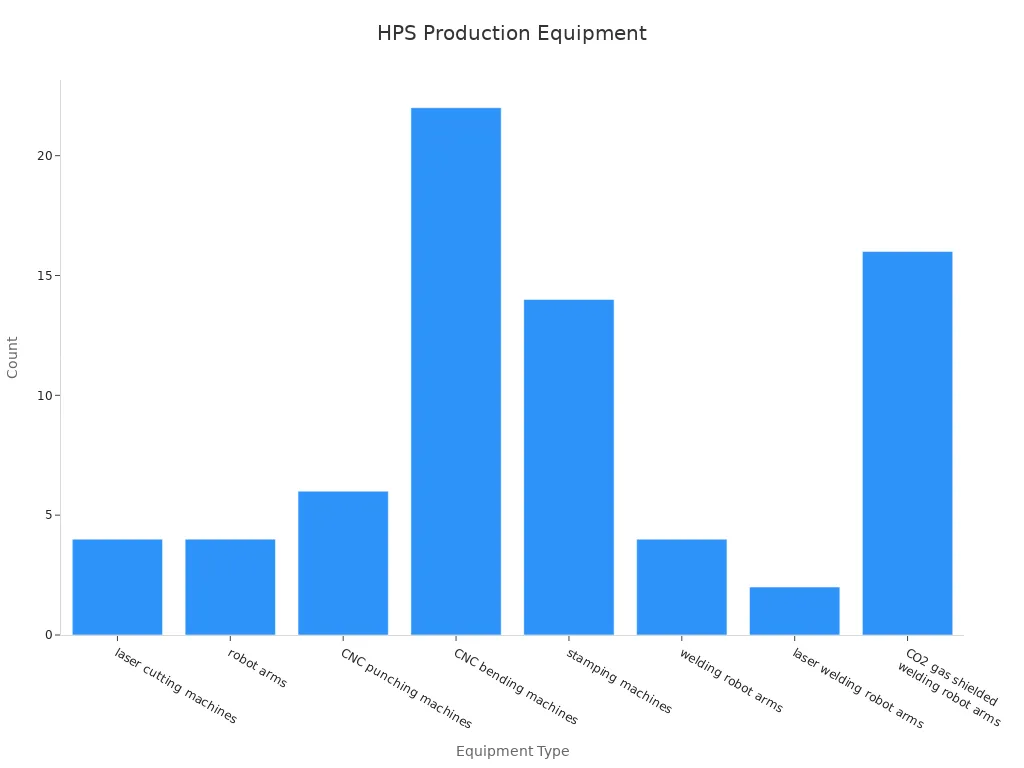
HPS backs every claim with third-party verification. Intertek audited the factory on-site, and the report (No. 474194629_P+T) stays valid through July 2026. The company also holds IATF 16949 certification for automotive work and ISO 9001:2015 for quality management. You can review the equipment that supports these credentials:
|
Category |
Verified Detail |
|---|---|
|
Cutting and Forming |
4 laser cutters, 6 CNC punches, 22 CNC bending machines, 14 stamping machines |
|
Welding and Automation |
4 welding robot arms, 2 laser welding arms, 16 CO2 shielded welding arms, 4 robot arms |
|
Quality Control |
11 QC inspectors, 10 QC stages, 6 testing instruments including a 3D scanner and X-ray coating gauge |
|
Scale |
175 employees, 19,549 m² facility, established 2003 |
HPS employs 36 R&D engineers who review your drawings before production starts. They run DFM and DFA reviews during early design phases, so you catch manufacturing risks before design freeze. The team tracks metrics such as first-pass yield, scrap rate, and engineering change notices. You receive technical solutions, not just quotations.
HPS exports 100% of its output to Eastern Europe, Southeast Asia, Western Europe, and other regions. Twenty-two years of export experience means the team understands customs documentation, RoHS declarations, and international payment terms. You get clear communication in English and support across T/T, L/C, and other payment methods.
Each industry imposes its own standards on your fabrication partner. You must match the supplier's certifications and process controls to your product's regulatory environment.
Automotive work demands IATF 16949 certification. This standard focuses on risk management, defect prevention, and continuous improvement. Your supplier must control production with FAI, FMEA, SPC, MSA, and PPAP documentation. EV programs add further demands. Battery enclosures, charging systems, and energy storage structures require high dimensional consistency, lightweight yet strong materials, enhanced corrosion resistance, and full production traceability. You should confirm the factory can stamp, resistance weld, laser weld, and hydroform components such as battery trays, underbody structures, and body-in-white parts. Material selection matters too. Aluminum alloys, advanced high-strength steels, and copper conductors each serve specific functions in your assembly.
Medical fabrication leaves no room for error. Your partner must meet strict requirements across every production stage.
|
Requirement Area |
Specific Requirement |
|---|---|
|
Precision |
Extreme precision with tight tolerances |
|
Materials |
Biocompatible materials such as stainless steel 316L |
|
Surface Finishes |
Sterilization-resistant surface finishes |
|
Traceability |
Full material traceability |
|
Regulatory Compliance |
Strict compliance with ISO 13485 and FDA regulations |
Enclosure fabrication requires you to plan finishing, masking, printing, hardware installation, and assembly before the first panel is cut. These operations affect dimensions, feature placement, and production sequence. A coating may cover a grounding point. Printed labels may conflict with a fastener. Your supplier must design cable management features such as formed channels, tie-down tabs, and edge grommets. PCB mounting requires standoffs that determine isolation versus grounding. Industry standards also apply. Telecommunications enclosures need EIA-310 rack compatibility. Medical electronics follow IEC 60601-1 for grounding and creepage.
Aerospace suppliers must hold AS9100 certification alongside ISO 9001:2015. Under AS9100, every measuring instrument requires unique identification, a documented calibration interval, and an unbroken traceability chain to a national standards body. Your partner must verify parts with CMM equipment and validate material specifications against aerospace safety standards.
Aerospace components routinely specify tolerances of ±0.005 inch or tighter, particularly for tube assemblies, hydraulic fittings, and structural mating surfaces — parts that have to perform reliably across pressure ranges of 3,000 to 5,000 psi and temperature swings from -65°F to +275°F.
Surface treatments such as powder coating, anodizing, and plating protect against corrosion and wear in harsh environments. A qualified China Sheet Metal Fabrication partner will hold these certifications and apply these controls to your program.
You need a structured approach before you contact any supplier. Start with these essentials: a complete CAD file, material specifications, thickness, surface finish requirements, quantity, and tolerance expectations. A qualified China Sheet Metal Fabrication partner will request every one of these items before quoting.
Verify these supplier capabilities during pre-qualification:
Equipment matching your part — request a specific equipment list and verify via video call.
Real certifications — confirm current ISO 9001:2015 covering the actual plant.
Visible quality system — ask about CMM reports, first-article inspection, and batch sampling.
Relevant industry experience — seek case studies in your sector.
One-stop vs. multi-step — confirm critical steps happen in-house.
Engineering support — look for DFM feedback on material grades and bend radii.
Crisis-proof communication — test English responsiveness within 24 hours.
Capacity and lead time honesty — ask for current utilization rates.
Transparent pricing — require quotes that separate tooling cost, piece price, and MOQ.
Path to scale — choose a supplier with both prototype and high-volume capacity.
Watch for these red flags: no equipment list, no inspection reports, mysterious tooling fees, no industry references, and instant yes to everything.
Before you release a purchase order, confirm the first article inspection report, material certifications, and a signed drawing revision. You must approve the FAI before full production begins.
Track defect rates, on-time delivery, and communication responsiveness. Request inspection reports with every shipment. Review corrective action reports when issues arise.
Match your supplier's size and specialization to your product complexity and volume. Prioritize verified quality systems, engineering support, and export experience over the lowest quote. Start with a prototype or pilot order to validate capabilities before full production. Document every specification, inspection criterion, and change control procedure. Consider a dual-supplier strategy to mitigate risks and secure supply in 2026. Partnering with an experienced China Sheet Metal Fabrication provider streamlines sourcing, improves quality, and speeds your market entry.
You request a live video tour, check the business license scope, and verify certifications through issuing bodies. HPS welcomes unannounced audits and provides Intertek reports.
You need ISO 9001:2015 as a baseline. Automotive work requires IATF 16949. Medical projects demand ISO 13485. Aerospace programs need AS9100D. HPS holds ISO 9001 and IATF 16949.
Most factories set minimums between 50 and 100 pieces. Prototype orders often start lower. HPS supports small-batch runs and scales to high-volume production without changing tolerances.
 Get a Quote Now


 IPv6 Network Supported
Leave A Message
Scan to Wechat :

Scan to Whatsapp :

Hi! Click one of our members below to chat on

 English
 Français
 Deutsch
 Русский
 Italiano
 Español
 Nederland
 日语
 한국어
 Svenska