
The first step in translating a 3D CAD model into a physical sheet metal component is blanking—cutting the flat 2D profile out of raw material. In modern sheet metal fabrication, engineers and procurement managers must choose between two dominant technologies: Fiber Laser Cutting and CNC Punching. While both machines achieve the same fundamental goal of separating metal, their operational mechanics, tooling costs, and physical impacts on the raw material are drastically different.
Selecting the wrong cutting technology during the Design for Manufacturing (DFM) phase can unnecessarily inflate tooling budgets, compromise edge quality, and delay production schedules. To optimize your manufacturing strategy, it is critical to understand the technical boundaries of each method. Here is an authoritative, deep-dive comparison to help you determine which cutting technology is best suited for your specific hardware requirements.
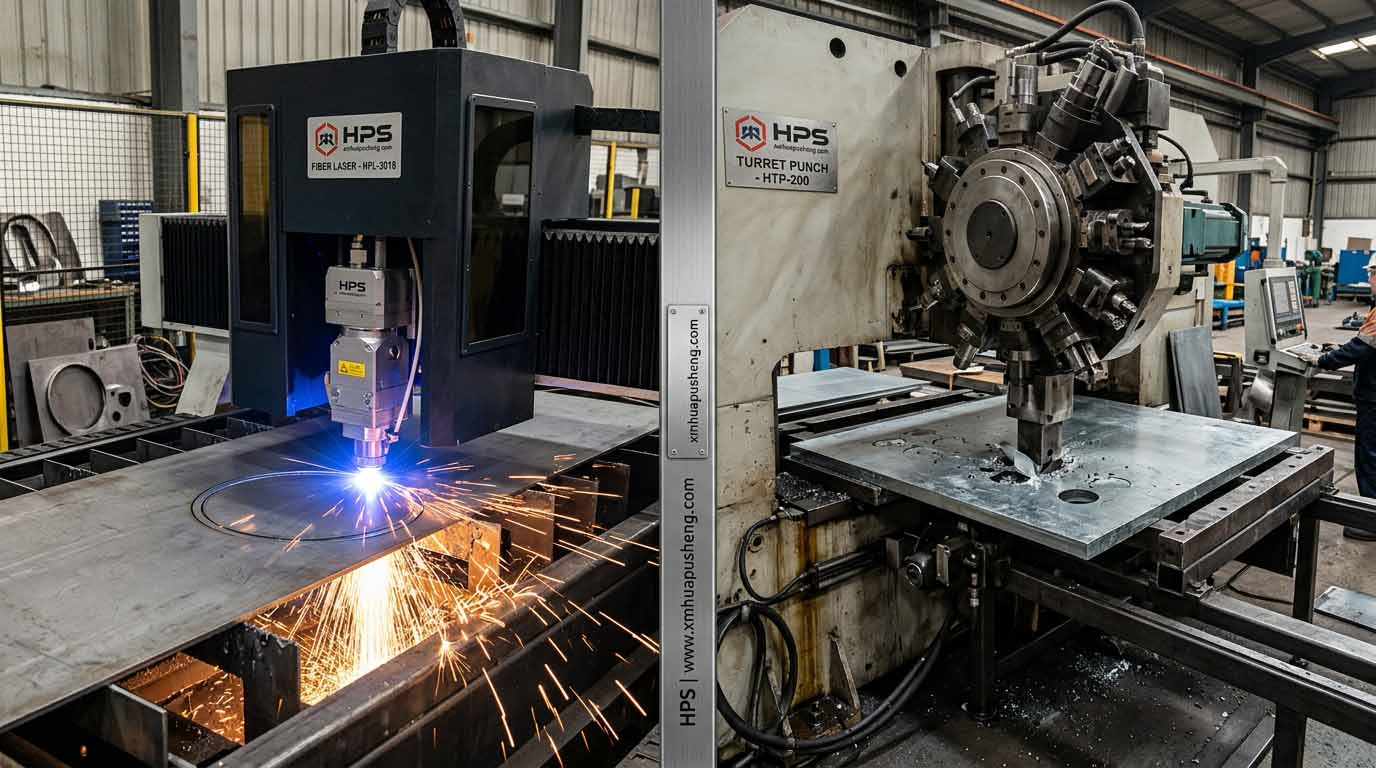
Fiber laser cutting utilizes a highly concentrated beam of light, generated by active optical fibers and delivered directly to the cutting head without the need for complex mirrors. Assisted by high-pressure cutting gases (such as nitrogen to prevent oxidation or oxygen to accelerate the burn), the laser melts and instantly vaporizes the metal. Because the laser beam has an extremely narrow kerf (often less than 0.2mm), it can execute impossibly tight internal radii and acute angles.
The greatest advantage of laser cutting is its absolute tooling freedom. There are no physical punches or dies required. If your engineering team uploads a highly complex, organic geometry with sweeping curves and irregular cutouts, the laser will execute it flawlessly in seconds. This makes fiber lasers the ultimate choice for rapid prototyping and low-to-medium volume manufacturing, especially for highly aesthetic assemblies like Precision Galvanized Steel Cabinets, where pristine, burr-free edge quality is absolutely non-negotiable.
Unlike the thermal process of a laser, a CNC turret punch press operates purely on mechanical shearing force. The machine houses a rotating turret filled with dozens of hardened steel punches and dies of various shapes (squares, circles, rectangles). The sheet metal is rapidly moved along the X and Y axes via clamps, and a hydraulic ram forces the tool through the metal, stamping out the required shape into a scrap bin below.
While a laser traces the perimeter of a 2-inch circle (taking a few seconds to travel the circumference), a CNC punch can stamp out that exact same circle in a fraction of a second with a single hit. Therefore, if a design features hundreds of identical ventilation holes or standardized mounting grids, CNC punching is exponentially faster. When scaling up into mass production, this "hits-per-minute" (HPM) advantage makes punching highly cost-effective.
If evaluating 2D cutting alone, lasers often win on flexibility. However, a CNC punch press can perform operations that a laser physically cannot: 3D forming. By utilizing specialized forming tools in the turret, a punch press can manipulate the Z-axis of the metal.
A punch press can create ventilation louvers, electrical knockouts, dimples, countersinks, extruded holes, and even tap threaded holes directly into the flat sheet. If you design a part using a laser, any required louvers or tapped holes must be completed in a secondary, labor-intensive machining step. A CNC punch completes the cutting and the 3D forming simultaneously on the same machine bed. This consolidation drastically reduces material handling time when fabricating complex hardware like Industrial Power Distribution Housings.
The choice between the two technologies is heavily dictated by the raw material's thickness and reflectivity. Modern 12KW to 20KW fiber lasers can slice through 20mm (or thicker) carbon steel with incredible ease. They handle thick plate cutting flawlessly without placing immense mechanical stress on the machine components.
Conversely, CNC punching is strictly limited by the tonnage of the hydraulic ram. Punching is typically restricted to thinner gauges—generally maxing out around 6mm (1/4 inch) for mild steel, and even thinner for stainless steel. Attempting to punch metal thicker than this causes rapid tool wear, excessive machine vibration, and heavy edge deformation.
However, for highly reflective metals like copper and brass, old CO2 lasers struggled because the beam would bounce back and damage the optics. While modern fiber lasers handle copper much better, punching remains a highly reliable, thermal-free alternative for highly conductive busbars.
Because laser cutting is a thermal process, it inherently creates a Heat-Affected Zone (HAZ) along the cut line. The extreme localized heat alters the metallurgical structure of the metal edge, which can slightly harden carbon steel. If your design requires a secondary operation like tapping a thread into a laser-cut hole, the hardened edge can quickly snap the tapping tool.
On the other hand, CNC punching is a cold mechanical shearing process. It does not alter the metal's hardness. However, punching creates a physical "rollover" on the top side of the cut and a small, sharp burr on the bottom side (the breakout zone). For safety and powder coating adhesion, these mechanical burrs must be removed using automated deburring machines before the parts proceed to the bending department.
When designing for manufacturability, the choice of machine directly dictates how small your features can be. The general engineering rule for CNC punching is that the diameter of a hole must be equal to or greater than the thickness of the material (Diameter ≥ 1T). If you attempt to punch a 1mm hole in 2mm thick steel, the punch tool will snap under the pressure.
Fiber lasers bypass this physical limitation. Because light exerts zero physical force on the sheet, a laser can comfortably cut holes with a diameter equal to half the material thickness (Diameter ≥ 0.5T). If your design requires micro-perforations in thick metal, laser cutting is your only viable option.
For prototyping and short runs, laser cutting is cheaper because there is zero upfront tooling investment. However, as production scales into the tens of thousands of units, the unmatched speed of the CNC punch press amortizes the initial tooling cost, making the per-part price significantly lower.
The most advanced sheet metal fabricators do not force OEMs to choose just one. Elite facilities operate combination machines or run both technologies in tandem. The laser can be used to cut the intricate outer perimeter of Heavy-Duty Telecommunication Racks, while the CNC punch is used to rapidly stamp out the internal ventilation matrix and form the countersinks. Partnering with a manufacturer equipped with both technologies guarantees that your product is processed using the most efficient, cost-effective method available.
Why are "nibble marks" found on some sheet metal parts?
Nibble marks occur when a CNC punch press is used to cut a large curved shape by making hundreds of small, overlapping circular punches. This leaves a slightly scalloped or jagged edge. If a perfectly smooth, continuous curve is required, laser cutting is the superior choice.
Are custom tools required for CNC punching?
For standard squares, rectangles, and circles, fabricators already own extensive standard tooling libraries. However, if your design requires a highly specific custom shape (like a proprietary logo cutout or a unique louver size), a custom punch tool must be manufactured, adding lead time and upfront cost.
Can laser cutting cause metal to warp?
Yes. If a design features a massive cluster of small holes cut very close together, the intense, localized heat from the laser can cause thin-gauge metal to thermally distort or warp. In these specific "high-density perforation" scenarios, a cold CNC punching process is often preferred to maintain sheet flatness.
 Get a Quote Now


 IPv6 Network Supported
Leave A Message
Scan to Wechat :

Scan to Whatsapp :

Hi! Click one of our members below to chat on

 English
 Français
 Deutsch
 Русский
 Italiano
 Español
 Nederland
 日语
 한국어
 Svenska