

Balancing strict engineering requirements with aggressive procurement budgets is a daily challenge for hardware developers. When moving a product from the prototyping phase to mass production, hidden manufacturing inefficiencies can quickly inflate unit prices. Often, the initial reflex is to source cheaper raw materials or compromise on the environmental protection rating. However, these shortcuts inevitably lead to field failures, warranty claims, and severe damage to a brand's reputation.
Real cost reduction in manufacturing is not about cutting corners; it is about intelligent Design for Manufacturing (DFM) and strategic supply chain consolidation. By optimizing how a flat sheet of metal is cut, folded, joined, and finished on the factory floor, OEMs can strip out unnecessary labor and machine setup time. Here is an authoritative, step-by-step breakdown of how to drastically reduce your sheet metal fabrication costs while maintaining absolute structural integrity and quality.
The most immediate way to drive down costs begins before the metal is even cut. Specifying exotic alloys or non-standard material thicknesses creates a logistical nightmare for fabricators. If you specify a 13-gauge steel when a highly common 14-gauge or 12-gauge would suffice, the factory cannot utilize their bulk purchasing power. They will have to special-order a small batch of raw material just for your project, passing the premium pricing and extended lead times directly onto you.
To maximize purchasing leverage, always design your components around standard sheet gauges and universally available materials like 304 stainless steel, 5052 aluminum, or standard cold-rolled carbon steel. For heavy-duty infrastructure like Custom Telecom Server Racks, standardizing the structural framing to a single gauge across the entire assembly allows the manufacturer to nest all the parts on a single sheet, pushing material utilization rates past 90% and virtually eliminating scrap waste.
Engineers transitioning from CNC machining to sheet metal often carry over overly strict tolerancing habits. While a 5-axis CNC mill can effortlessly hold a ±0.005-inch tolerance, achieving that same precision on a sheet metal press brake is incredibly labor-intensive. Metal naturally exhibits "spring-back" after bending, and variations in material grain direction can cause microscopic shifts in the final angle.
If every single hole and fold on your drawing demands aerospace-level precision, the factory must use specialized tooling, perform manual test bends, and slow down the entire production line for rigorous quality checks. The solution is selective tolerancing. Apply strict tolerances only to critical mating surfaces, hardware insertion points, or moving mechanisms. Let the rest of the chassis adhere to standard commercial sheet metal tolerances. This single adjustment can lower production costs by up to 30%.
Press brake operation is a major cost center in any fabrication shop. Every time an operator has to change the upper punch and lower V-die to accommodate a different bend radius, the machine sits idle. If your design features three different bend radii, you are paying for three separate machine setups.
By following comprehensive sheet metal design guidelines, you should mandate a uniform inside bend radius (typically 1T, equal to the material thickness) across all flanges of a part. This allows the press brake operator to program a continuous bending sequence, rapidly manipulating the flat pattern without ever stopping to swap out heavy tooling.
Welding is highly effective for heavy structural frames, but it is also one of the most expensive and time-consuming processes in metalworking. Beyond the skilled labor required to lay a flawless TIG or MIG bead, the extreme heat introduces distortion into thin-gauge metals. Correcting this thermal warpage requires aggressive manual grinding and sanding to restore a flat surface before powder coating.
Whenever structural requirements permit, engineer the assembly to use mechanical fasteners instead. Designing interlocking tab-and-slot joints, utilizing structural blind rivets, or pressing in self-clinching hardware (like PEM nuts) is infinitely faster than welding. For internal electronics mounting, such as in Precision Medical Device Chassis, using pressed-in standoffs rather than welded studs ensures absolute perpendicularity and eliminates the need for expensive post-weld cleanup.
A common mistake is designing a metal box by drawing six separate flat panels and assuming they will be bolted or welded together. Every individual part you design generates its own unique CAD file, requires its own laser cutting program, must be individually handled, inventoried, and eventually assembled. This exponentially drives up manufacturing overhead.
Modern 3D CAD software allows you to visualize folded structures easily. Aim to consolidate multiple components into a single, complex flat pattern that can be folded into shape. A single piece of sheet metal with four bends is vastly cheaper to produce than five flat pieces of metal that require meticulous welding fixtures and alignment jigs.
Cosmetic finishes are necessary for both branding and corrosion resistance, but they represent a significant portion of the final unit cost. Specifying multiple colors on a single part requires tedious masking tape application by hand before painting, doubling the labor time.
Keep it simple: utilize a single, universally applied powder coat color for the main chassis. If the part is purely internal and will never be seen by the end-user, ask yourself if it needs painting at all. Using pre-galvanized steel sheets allows internal brackets to remain completely unpainted while still retaining excellent rust resistance. This highly efficient strategy is commonly employed when manufacturing high-volume NEMA Rated Control Panels.
The hidden killer of procurement budgets is supply chain fragmentation. If you pay one factory to cut the metal, pay freight to ship it to a specialized bending shop, and then ship it again to a third-party coating facility, you are absorbing massive logistical costs and markup at every single stage.
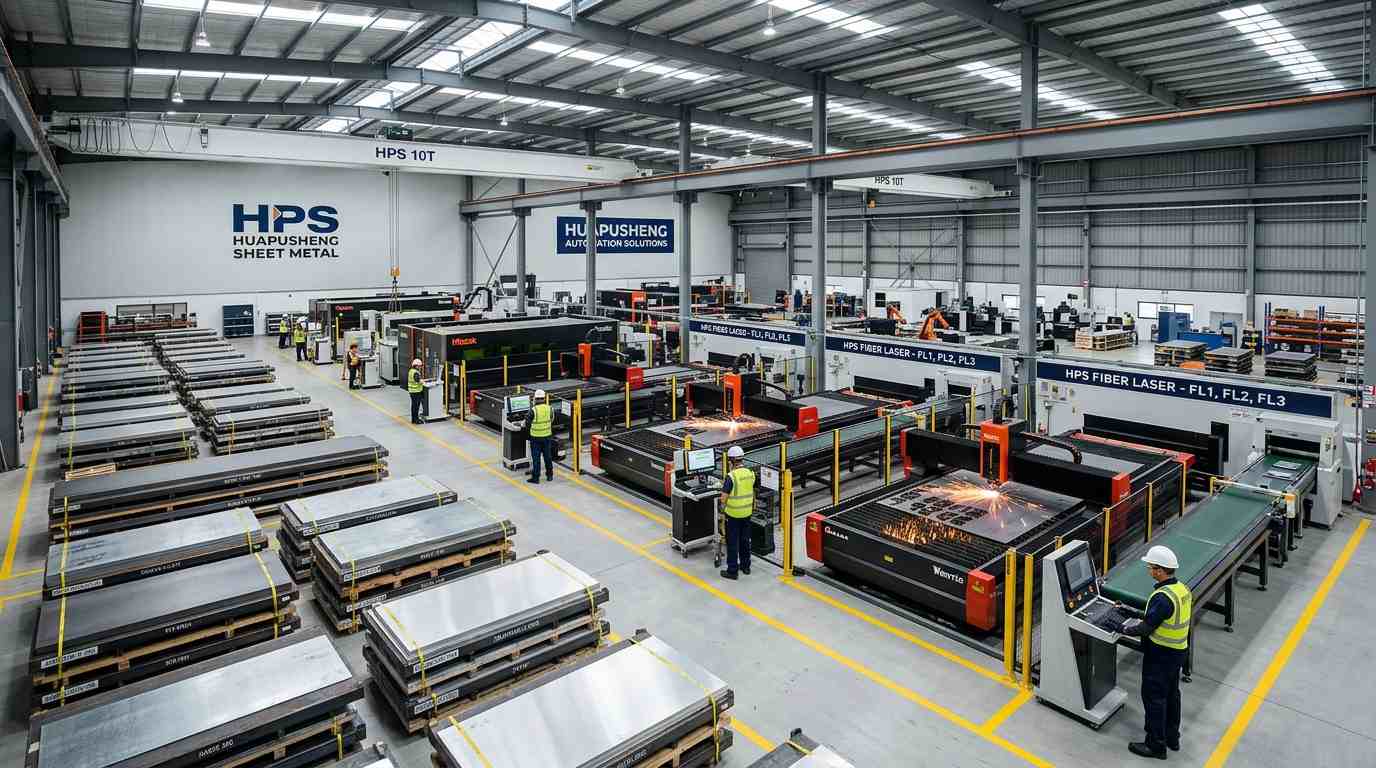
Consolidating your vendor list is the ultimate cost-reduction strategy. Partnering with a large-scale facility that possesses advanced manufacturing capabilities entirely in-house eliminates transport delays and concentrates quality accountability into a single entity. At Huapusheng, we control the entire lifecycle—from laser profiling to automated powder coating—under one roof. Consult with our fabrication specialists to review your 3D models and discover how we can optimize your custom metal fabrication projects for maximum profitability.
Does powder coating cost more than traditional wet paint?
In modern automated facilities, powder coating is actually more cost-effective for medium to high-volume production. Unlike wet paint, oversprayed powder can be recovered and reused, driving material waste down to nearly zero. Additionally, it cures much faster in the oven, speeding up delivery times.
Why should I avoid placing holes too close to a bend?
Placing a hole inside the bend deformation zone will cause the circle to stretch into an oval shape during the folding process. To fix this, the factory must laser-cut the part solid, bend it, and then set up a secondary CNC milling operation to drill the hole perfectly round, which adds unnecessary labor costs.
Can aluminum be welded as easily as carbon steel?
No. Aluminum dissipates heat extremely quickly and has a lower melting point, requiring highly skilled TIG welders and specialized AC (Alternating Current) welding machines. If you are trying to reduce costs on an aluminum assembly, mechanical fastening (like riveting) is highly recommended over welding.
 Get a Quote Now


 IPv6 Network Supported
Leave A Message
Scan to Wechat :

Scan to Whatsapp :

Hi! Click one of our members below to chat on

 English
 Français
 Deutsch
 Русский
 Italiano
 Español
 Nederland
 日语
 한국어
 Svenska