
Outsourcing your manufacturing to China offers undeniable cost advantages and massive scalability. However, managing a fragmented supply chain—where one factory cuts the metal, another bends it, and a third handles the powder coating—often leads to blown deadlines, communication breakdowns, and highly inconsistent quality. For OEMs and hardware developers, the most effective and profitable solution is partnering with a true "one-stop" sheet metal fabricator.
When you split a project across multiple vendors, you inevitably face the dreaded "blame game." If a powder-coated part arrives with flaking paint, the coating facility will blame the fabricator for leaving cutting fluids on the metal, while the fabricator will blame the coater's curing oven. By the time the issue is resolved, your production schedule is ruined. Consolidating your manufacturing eliminates this risk by assigning total accountability to a single entity.
But how do you separate the genuine full-service manufacturers from trading companies or small workshops that secretly outsource your complex jobs? Finding a reliable partner requires looking far beyond the initial price quote and deeply evaluating their in-house capabilities, engineering support, and quality control systems. Here is the ultimate guide to choosing a reliable one-stop sheet metal fabrication partner in China.
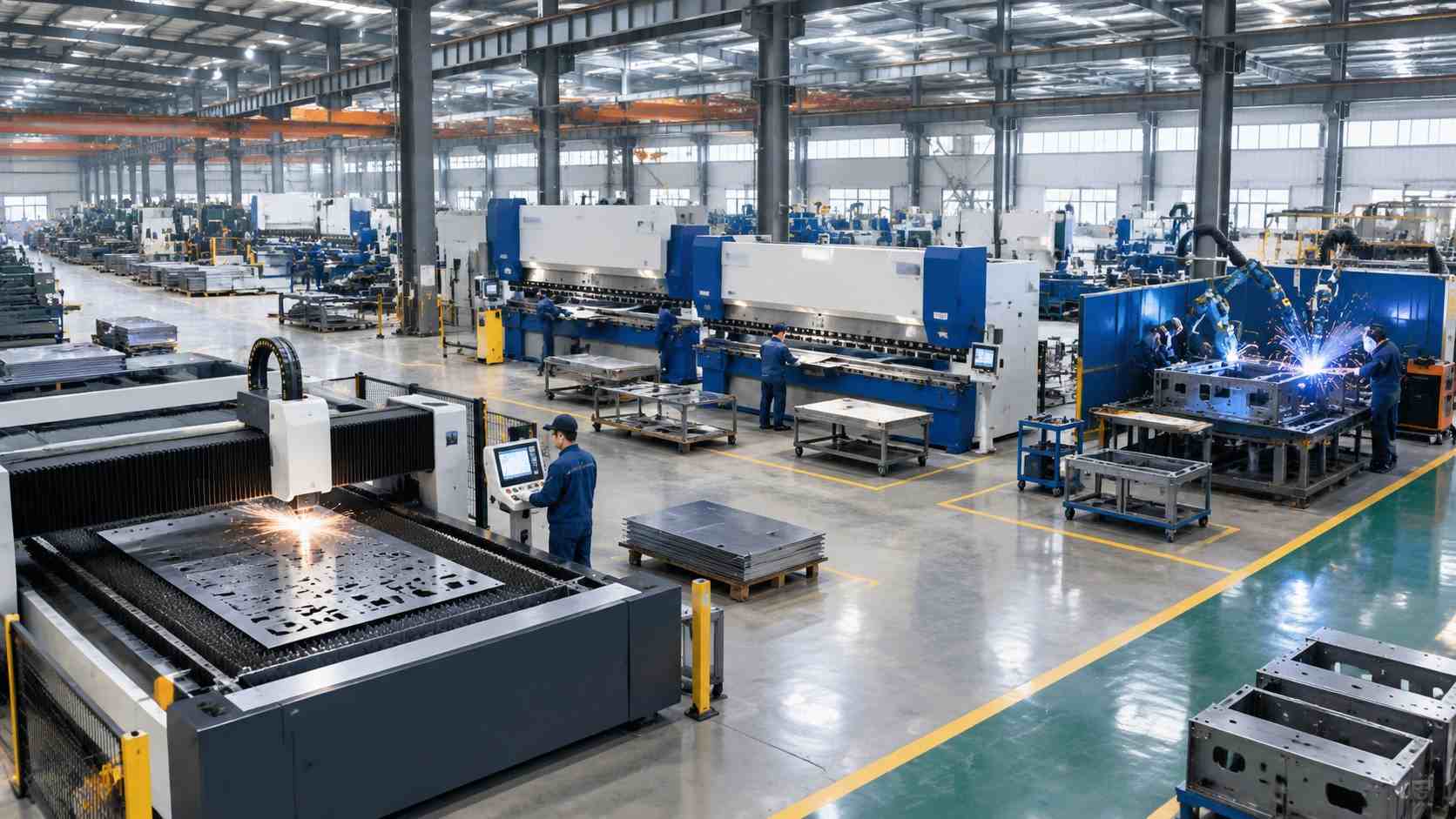
A genuine one-stop partner must control the entire production lifecycle under one roof. When a factory has to outsource critical steps like CNC bending, robotic welding, or hardware insertion, you immediately lose control over lead times and dimensional tolerances.
During your evaluation phase, explicitly ask for a detailed equipment list. Look for modern, high-tier machinery such as 12KW+ fiber lasers, automated CNC press brakes with multi-axis backgauges, and robotic welding cells. A fabricator equipped with this level of technology is fully capable of handling everything from simple flat brackets to complex, multi-component Custom Sheet Metal Enclosures without relying on third-party vendors.
Furthermore, true in-house capability extends to raw material procurement. A reliable partner will maintain a well-stocked warehouse of standard materials (like 304/316 stainless steel, 5052 aluminum, and galvanized carbon steel) to ensure rapid prototyping and buffer against sudden supply chain shortages.
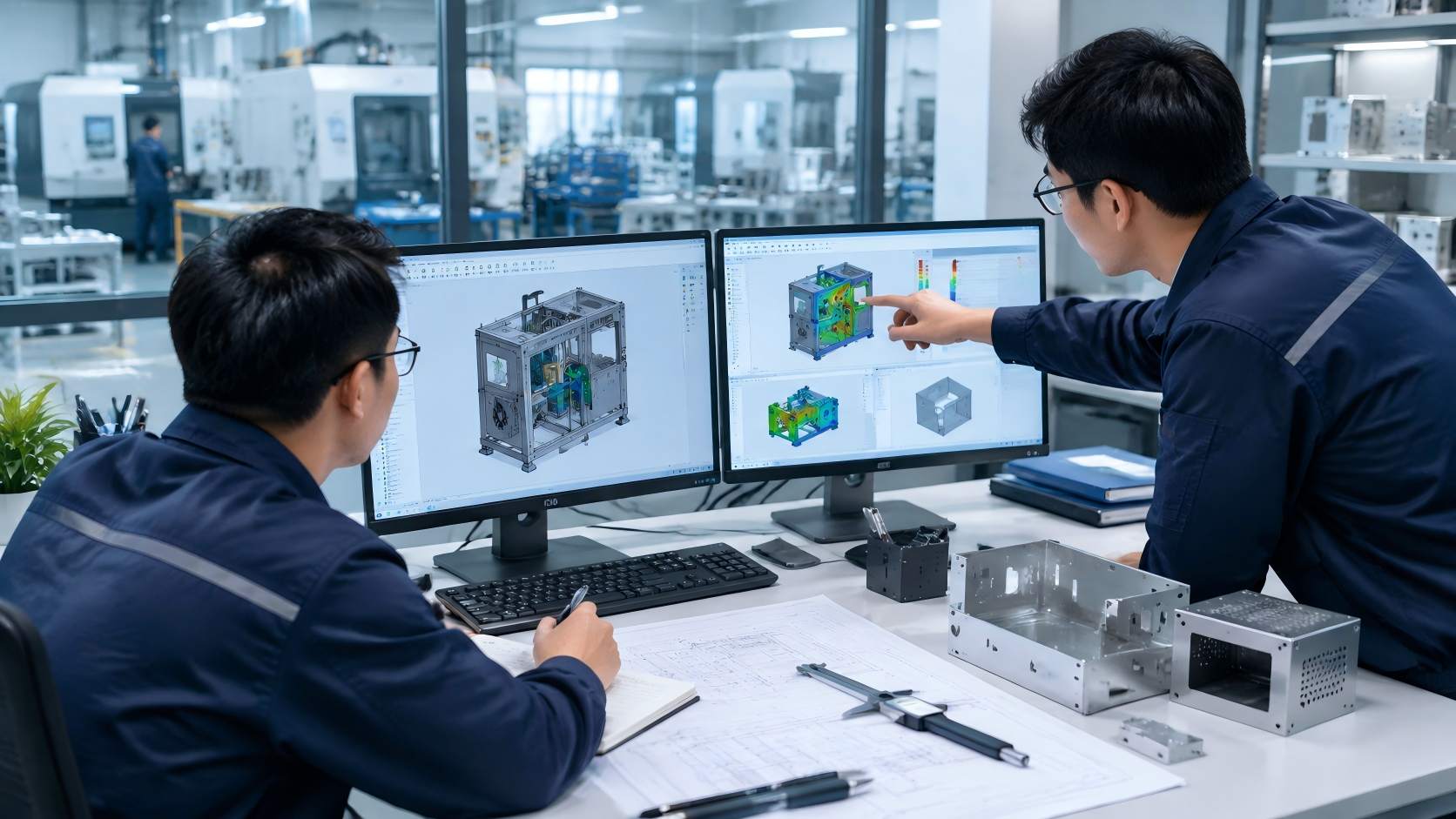
A high-quality manufacturing partner does not just blindly follow your CAD drawings. Often, designs that function perfectly in a 3D modeling software environment are unnecessarily expensive, slow, or difficult to mass-produce on the actual factory floor.
Look for a factory that provides proactive Design for Manufacturability (DFM) support. Their engineering team should meticulously review your STEP or SolidWorks files and suggest practical modifications. For example, an experienced engineering team might suggest converting a complex, five-part welded assembly into a single laser-cut and CNC-bent piece. This simple change drastically reduces welding labor and assembly time.
Whether you are producing heavy-duty telecom cabinets or lightweight Precision Stainless Steel Brackets, robust DFM engineering support ensures your product transitions from the prototyping phase to mass production smoothly, reliably, and economically.
The difference between an average supplier and an elite manufacturing partner almost always lies in the final finish. Raw laser-cut edges, hardened oxide layers, and messy weld spatters are unacceptable for consumer-facing products or high-end industrial machinery.
Ensure the manufacturer has dedicated, automated in-house post-processing solutions. Rather than relying on inconsistent and hazardous manual grinding, top-tier factories utilize automated Automatic Sheet Metal Deburring Machines to create perfect, uniform R-angles and strip away laser slag instantly. This ensures a flawless foundation for the next step.
Additionally, environmental regulations in China have become strictly enforced in recent years, leading to frequent, unexpected shutdowns of small, non-compliant painting facilities. Partnering with a factory that operates its own environmentally certified, in-house powder coating or electrophoretic painting (E-coat) line is crucial. It guarantees your parts are coated immediately after cleaning, preventing oxidation and securing your delivery timelines.
Trust is good, but verifiable data is always better. A reliable Chinese manufacturer should hold internationally recognized certifications—at a bare minimum ISO 9001, and preferably IATF 16949 if you are operating in the automotive, medical, or strict industrial sectors.
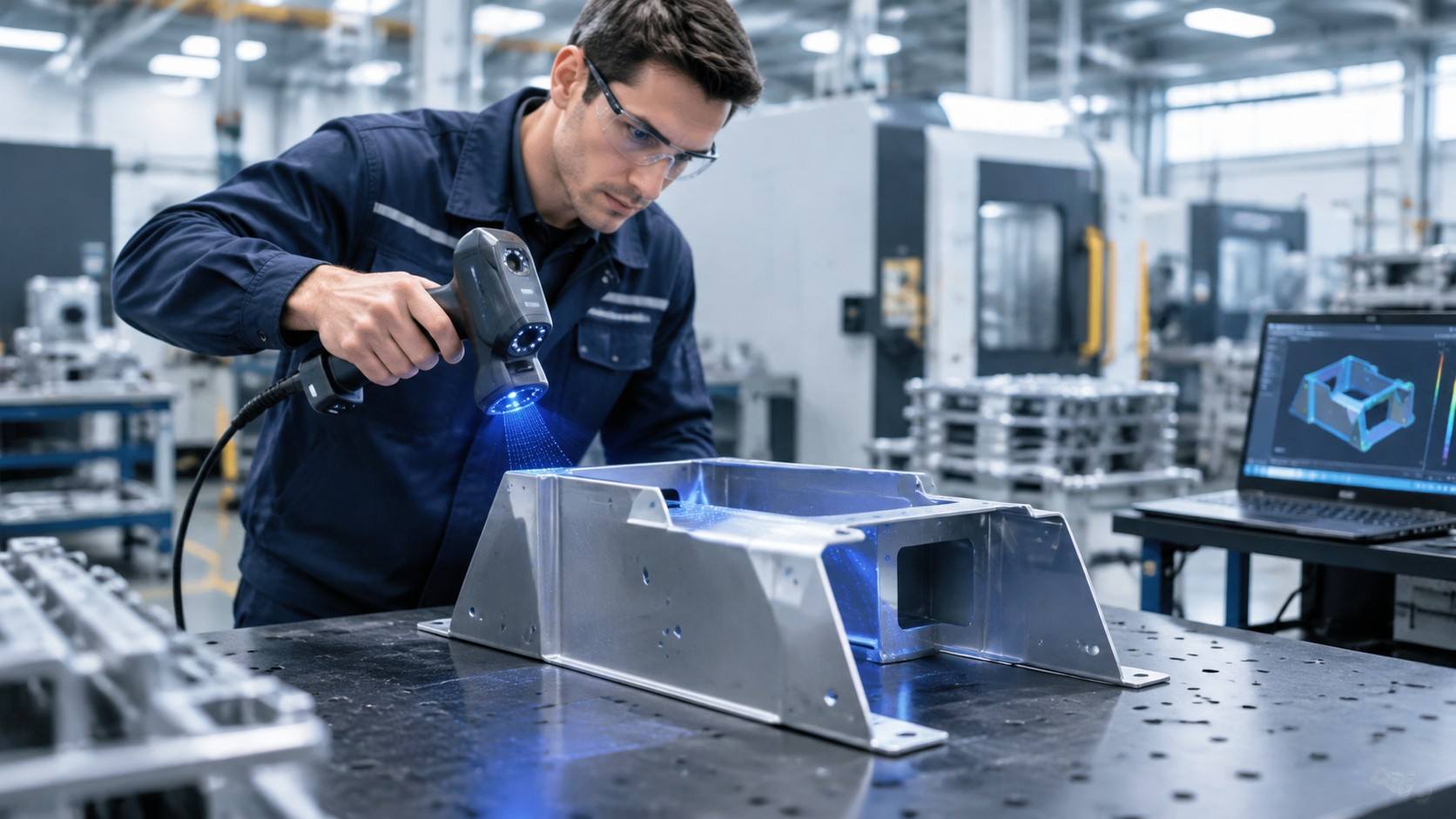
Ask detailed questions about their QA lab. Do they just use basic hand calipers, or do they employ advanced 3D optical scanners, planar inspection machines, and salt-spray testing chambers? A genuine one-stop shop will have the high-end metrology equipment necessary to validate strict tolerances and provide comprehensive First Article Inspection (FAI) reports before shipping the bulk order.
Traceability is equally crucial. A reliable one-stop fabricator will provide full documentation upon request, including Material Test Reports (MTRs) from the steel mills, RoHS compliance certificates for their powder coatings, and detailed inspection logs mapped to your specific batch numbers.
Even with the best laser cutters and robotic welders in the world, a manufacturing partnership will fail without transparent, responsive communication. The friction of language barriers and 12-hour time differences can quickly turn minor engineering revisions into massive production delays.
A top-tier one-stop fabricator will assign a dedicated, technically fluent account manager to your project. This single point of contact should be able to read CAD drawings, understand your specific tolerances, and provide weekly updates (often supported by an internal ERP system) showing exactly where your parts are on the factory floor. This level of transparency gives you the peace of mind that your project is on track.
Choosing the right one-stop sheet metal fabrication partner in China can help businesses simplify supply chain management, improve production efficiency, and achieve better cost control. A reliable partner should not only provide comprehensive manufacturing capabilities but also offer strong engineering support, consistent quality control, and transparent communication throughout the entire process.
At HPS, we provide integrated sheet metal fabrication solutions from our facility in Xiamen, including precision fabrication, robotic welding, automated surface finishing, and engineering assistance. By combining advanced equipment with experienced technical teams, we help customers streamline their manufacturing process and bring projects from design to production more efficiently.
If you are looking for a dependable manufacturing partner in China, feel free to share your drawings or project requirements with our team. We are committed to providing reliable, flexible, and efficient one-stop fabrication support.
 Get a Quote Now


 IPv6 Network Supported
Leave A Message
Scan to Wechat :

Scan to Whatsapp :

Hi! Click one of our members below to chat on

 English
 Français
 Deutsch
 Русский
 Italiano
 Español
 Nederland
 日语
日语 한국어
한국어 Svenska