
Designing an industrial metal enclosure requires more than selecting a suitable metal thickness or choosing a protective coating. Engineers must balance heat dissipation, ingress protection, structural strength, corrosion resistance, and installation requirements. An enclosure that provides excellent sealing may trap excessive heat, while an enclosure with large ventilation openings may expose sensitive electrical components to dust and moisture.
The most effective approach is to define operating conditions before finalizing the enclosure structure. Material selection, ventilation design, gasket placement, manufacturing tolerances, and surface treatment should work together as one engineering solution.
For equipment manufacturers, working with an experienced fabrication partner such as HUAPUSHENG can help address these requirements during product development rather than correcting design problems after production begins.
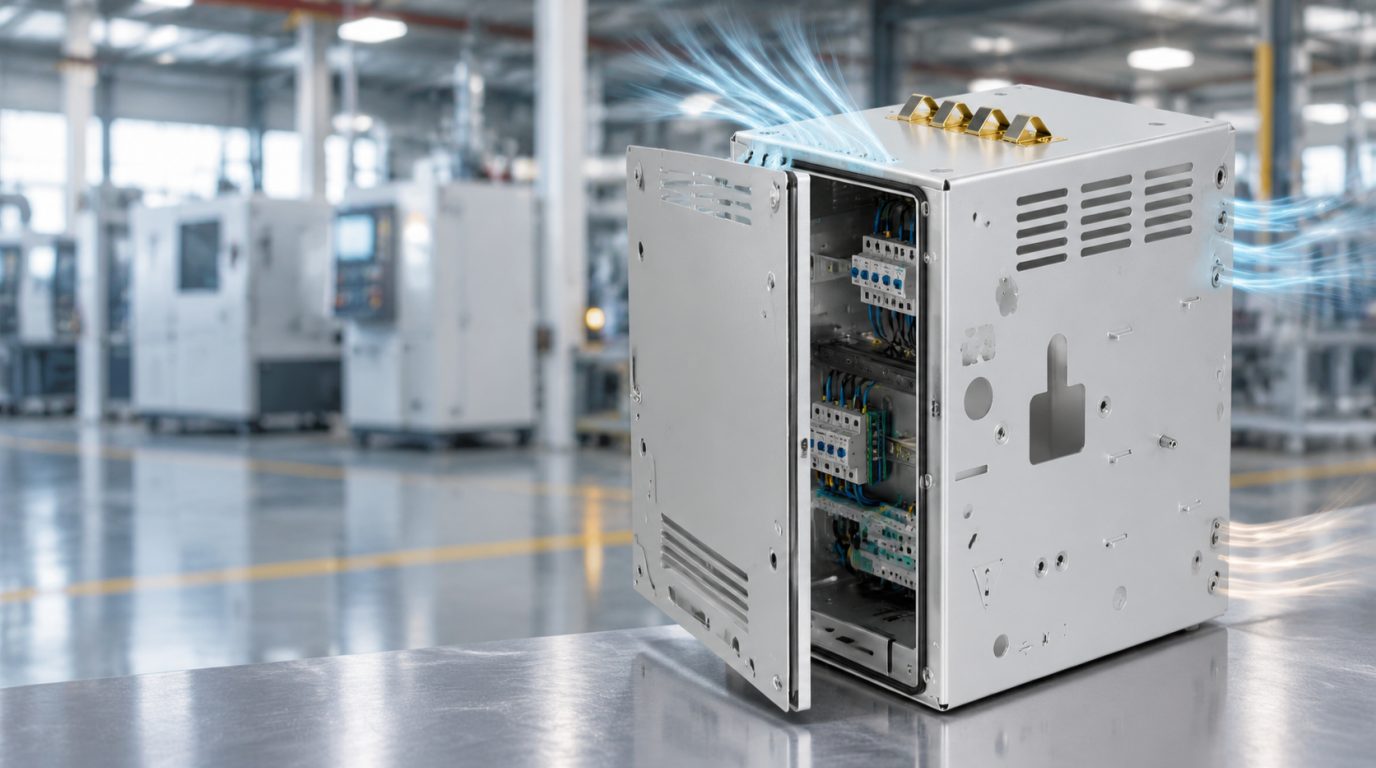
Electrical and electronic equipment generates heat during normal operation. Power supplies, circuit breakers, transformers, inverters, control modules, and communication devices all contribute to the internal thermal load.
When heat cannot escape efficiently, internal temperatures increase. This may accelerate component aging, reduce electronic reliability, trigger protective shutdowns, or shorten the service life of the entire system.
Three factors determine how effectively an enclosure manages heat:
The first step is identifying the total heat generated by the installed components. Engineers should distinguish between rated electrical power and actual heat dissipation. Not all electrical input power becomes heat inside the enclosure, so component efficiency and operating conditions must be considered.
Heat leaves an enclosure through three primary mechanisms:
Steel and aluminum offer different thermal characteristics. Aluminum generally provides higher thermal conductivity and lower density, while steel offers greater stiffness and is often selected for heavy-duty electrical cabinets and industrial structures.
An enclosure installed in an air-conditioned control room faces different thermal conditions from one mounted outdoors near industrial machinery. Solar radiation, surrounding equipment, airflow restrictions, and seasonal temperature variations can all influence internal temperatures.
HUAPUSHENG recommends evaluating the actual installation environment when developing customized enclosures, particularly for power distribution, energy storage, and industrial control applications.
For naturally ventilated or fan-assisted enclosures, estimating the required airflow provides a useful starting point for thermal design.
A commonly used preliminary engineering formula is:
Q = 3.1 × P / ΔT
Where:
Practical example: Assume an electrical enclosure generates 600 W of heat, and the design allows an internal air temperature rise of 10°C above ambient.
Q = 3.1 × 600 / 10 = 186 m³/h
This calculation indicates an initial airflow requirement of approximately 186 m³/h. The final fan selection should account for filter resistance, pressure losses, ventilation openings, fan performance curves, and operating conditions.
This is a preliminary estimate rather than a substitute for thermal simulation or temperature-rise testing. Where high heat loads or strict temperature limits exist, engineers may need forced-air cooling, heat exchangers, or dedicated air-conditioning systems.
One of the most challenging aspects of industrial enclosure engineering is maintaining adequate cooling without compromising environmental protection.
IP ratings are defined under IEC 60529. The first digit relates to protection against solid objects and dust, while the second digit describes protection against water ingress.
| Design Requirement | Common Engineering Approach | Potential Challenge |
|---|---|---|
| Dust protection | Sealed joints and suitable gaskets | Reduced natural airflow |
| Water protection | Sealed doors, cable glands, and drainage design | Potential water accumulation |
| Heat dissipation | Filtered ventilation or heat exchangers | Filter maintenance and airflow resistance |
| Outdoor installation | Weather-resistant coatings and sealed construction | UV exposure and corrosion |
| High-protection applications | Closed-loop cooling systems | Higher equipment and maintenance costs |
Several design details deserve particular attention:
For demanding applications, the final IP rating must be verified through appropriate testing. A design specification or the use of a gasket alone does not establish IP compliance.
Material selection affects more than the initial manufacturing cost. It influences thermal performance, structural rigidity, corrosion resistance, weight, fabrication complexity, and long-term maintenance.
| Material | Advantages | Considerations | Typical Applications |
|---|---|---|---|
| Carbon Steel | Strength, rigidity, cost efficiency | Requires suitable corrosion protection | Electrical cabinets and industrial frames |
| Stainless Steel | Corrosion resistance and durability | Higher material and processing costs | Harsh and humid environments |
| Aluminum Alloy | Low weight and good thermal conductivity | Different stiffness and joining characteristics | Power supply and electronic housings |
There is no universally best material. A lightweight aluminum enclosure may be suitable for electronic equipment, while a heavy-duty steel structure may better support large electrical components.
For projects requiring specialized housing structures, anodized aluminum power supply enclosure solutions can provide a useful reference for evaluating material and surface treatment requirements.
Even a well-engineered enclosure can fail to perform as expected if manufacturing inconsistencies affect panel alignment, door gaps, mounting positions, or welded joints.
Different fabrication processes contribute to different aspects of product quality.
Laser cutting produces accurate profiles and openings for ventilation, mounting holes, cable entries, and structural connections. CNC punching is particularly useful for repetitive holes and formed features in sheet metal components.
Bending accuracy influences the final enclosure dimensions and assembly fit. Engineers should consider material thickness, bend radius, bend allowance, springback, and tooling when preparing production drawings.
Welding joins structural components and creates rigid assemblies. However, excessive heat input can cause distortion, affecting door alignment and sealing surfaces. Appropriate welding sequences, fixtures, and dimensional inspections help control these problems.
For server racks and communication equipment, rackmount chassis precision welding assembly is particularly relevant because component alignment, mounting-hole positioning, and structural stability directly influence equipment installation.
Surface treatment determines how well an enclosure withstands environmental exposure, handling, and everyday operating conditions.
Common finishing options include:
For outdoor electrical cabinets, the coating system should be selected according to the actual corrosion category, substrate preparation, coating thickness, and applicable test requirements.
HUAPUSHENG provides integrated sheet metal finishing services, including powder coating, spray painting, anodizing, electrocoating, electroplating, and screen printing. Its automated powder coating line is 515 meters long and supports C4/C5-oriented corrosion protection requirements.
Before releasing an industrial enclosure design for mass production, procurement teams and engineering departments should review the following points.
| Project Stage | Items to Verify | Expected Result |
|---|---|---|
| Requirements | Heat load, ambient temperature, IP rating | Clear design targets |
| Engineering | Material, thickness, mounting, ventilation | Manufacturable design |
| Prototype | Dimensions, assembly, temperature, sealing | Design validation |
| Production | Cutting, bending, welding, finishing | Consistent manufacturing quality |
| Final Inspection | Critical dimensions, coating, functional tests | Verified product conformity |
Working with a supplier that integrates engineering support and manufacturing processes can reduce communication gaps between design and production. This is particularly important for customized enclosures with multiple welded parts, complex mounting structures, and strict assembly requirements.
For OEM buyers, selecting an enclosure manufacturer is not simply about finding a supplier that can cut and bend metal. The supplier must understand how individual manufacturing processes influence the final product.
Xiamen Huapusheng Sheet Metal Manufacturing Co., Ltd. was established in 2003 and specializes in precision sheet metal fabrication for electrical equipment, power control systems, communication equipment, and industrial applications.
Located in Xiamen Torch High-Tech Zone, HUAPUSHENG operates a 30,000 m² manufacturing facility with more than 200 employees, including 36 R&D and technical personnel. The company holds 32 patents and has developed manufacturing capabilities covering design support, fabrication, welding, surface treatment, and final assembly.
Its manufacturing equipment includes AMADA and TRUMPF laser cutting and CNC bending systems, together with automated welding equipment from established industrial brands such as Panasonic, Yaskawa, and Fanuc.
Several company milestones demonstrate its manufacturing development:
| Year | Development Milestone |
|---|---|
| 2003 | Company established and became a certified ABB supplier. |
| 2005 | Achieved ISO 9001 quality management certification. |
| 2013 | Moved to its self-owned 30,000 m² manufacturing facility. |
| 2016 | Achieved IATF 16949 quality management certification. |
| 2022 | Became a certified Schneider Electric supplier and upgraded its powder coating workshop automation. |
HUAPUSHENG's manufacturing experience covers power distribution cabinets, UPS enclosures, communication equipment housings, photovoltaic energy storage structures, and industrial equipment frames.
For projects requiring integrated fabrication and assembly, custom sheet metal enclosure fabrication can help consolidate cutting, punching, bending, welding, surface finishing, and final assembly within one manufacturing workflow.
The company also operates under ISO 9001, ISO 14001, ISO 45001, and IATF 16949 quality and management systems. These capabilities provide a manufacturing foundation for customers who require consistent production quality and long-term OEM cooperation.
There is no single best material for every application. Carbon steel is suitable for many heavy-duty cabinets, stainless steel is commonly selected for corrosive or demanding environments, and aluminum is useful where lower weight and thermal conductivity are important. The final choice should consider mechanical loads, operating conditions, corrosion exposure, and manufacturing costs.
Possible solutions include filtered ventilation, properly designed air channels, heat exchangers, and closed-loop cooling systems. The appropriate solution depends on the required IP rating, internal heat generation, and installation environment. The completed enclosure should undergo the relevant ingress protection testing.
No. Increasing sheet thickness can improve stiffness and load-bearing performance, but it also increases weight, material consumption, and forming requirements. Engineers should evaluate panel dimensions, structural loads, reinforcement methods, and mounting conditions before specifying thickness.
Typical processes include laser cutting, CNC punching, bending, stamping, welding, riveting, surface treatment, and assembly. The exact process combination depends on the enclosure structure, material, production volume, and required tolerances.
Yes. Xiamen Huapusheng Sheet Metal Manufacturing Co., Ltd. provides integrated sheet metal manufacturing services, including fabrication, welding, finishing, and assembly. Its engineering and production capabilities support customized components and enclosures for power equipment, communications, energy storage, and industrial applications.
Buyers should ideally provide 2D drawings, 3D CAD files, material specifications, sheet thickness, surface treatment requirements, annual demand, target IP rating, and installation conditions. Information about internal components and thermal loads is also helpful when the enclosure requires ventilation or cooling design.
Providing complete technical information allows the manufacturing team to evaluate material utilization, fabrication processes, assembly requirements, and potential design improvements before production.
Reliable industrial enclosures begin with a well-considered design and a manufacturing process capable of delivering consistent results. From material selection and precision fabrication to welding, surface treatment, and final assembly, every stage contributes to the performance of the finished product.
Xiamen Huapusheng Sheet Metal Manufacturing Co., Ltd. (HUAPUSHENG) provides integrated sheet metal solutions for global OEMs and industrial equipment manufacturers. If your project involves power distribution cabinets, communication equipment housings, energy storage enclosures, or customized metal components, HUAPUSHENG can work with your team to evaluate drawings and manufacturing requirements.
Visit HUAPUSHENG's official website to explore its manufacturing capabilities and discuss your next project.
 Get a Quote Now


 IPv6 Network Supported
Leave A Message
Scan to Wechat :

Scan to Whatsapp :

Hi! Click one of our members below to chat on

 English
 Français
 Deutsch
 Русский
 Italiano
 Español
 Nederland
 日语
 한국어
 Svenska