
Transforming flat 2D metal blanks into functional 3D assemblies requires joining multiple pieces of sheet metal together. In modern manufacturing, selecting the correct joining method is one of the most consequential Design for Manufacturing (DFM) decisions an engineer can make. The method chosen directly dictates the product's structural rigidity, aesthetic finish, IP rating, electromagnetic compatibility (EMC), and ultimately, its mass production cost.
While there are numerous ways to assemble hardware—including modern structural adhesives—the industrial hardware sector heavily relies on three primary techniques: Welding, Blind Riveting, and Self-Clinching Fasteners (often referred to as PEM hardware). Each of these technologies presents unique engineering advantages and inherent physical limitations that must be evaluated during the CAD design phase. In this comprehensive technical guide, we will deeply analyze the mechanics of each joining method to help you determine the most cost-effective and reliable solution for your specific sheet metal project.
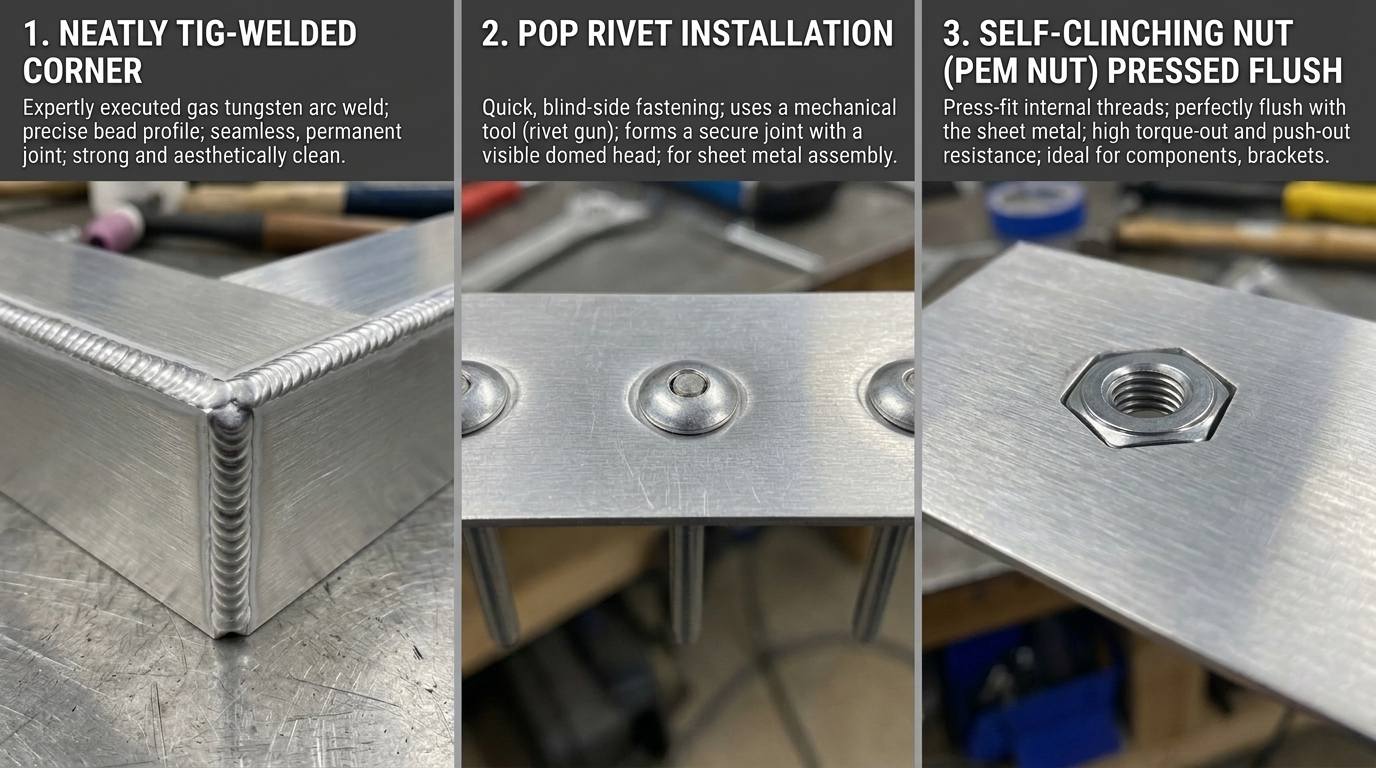
Welding involves melting the base metals (often with an added filler material) to fuse two separate components into a single, continuous piece of metal. Within sheet metal fabrication, this is generally broken down into two distinct sub-categories: continuous TIG/MIG welding and Resistance Spot Welding (RSW).
The Advantages of Continuous Welding: Continuous seam welding provides unmatched tensile and shear strength. More importantly, it creates a permanent, watertight, and dustproof seal. If you are manufacturing Heavy-Duty Outdoor Telecom Equipment Racks that require strict IP65 or IP66 environmental ratings, robotic continuous welding is absolutely mandatory to prevent moisture and salt spray ingress.
The Advantages of Spot Welding: For internal components where waterproofing is not required, spot welding is highly efficient. It uses copper electrodes to pass a massive electrical current through overlapping metal sheets, melting them together at a precise point in milliseconds. It is much faster than TIG welding and introduces far less heat into the assembly.
The Disadvantages: The primary enemy of welding is intense, localized heat. For thin-gauge materials (under 1.5mm), this heat inevitably causes severe thermal distortion and warpage. Restoring the metal to a flat, cosmetically acceptable state requires aggressive manual grinding and sanding, which drastically increases labor costs. Additionally, welding dissimilar metals (like aluminum to carbon steel) is generally not feasible using standard industrial methods.
Blind riveting (commonly known as pop riveting) is a mechanical fastening process designed for situations where the operator only has access to one side of the assembly. A rivet is inserted into pre-punched, aligned holes in two pieces of metal. A pneumatic rivet gun then pulls the mandrel through the rivet body, expanding it on the blind side and clamping the sheets tightly together.
The Advantages: Riveting is a strictly "cold" joining process. Because there is zero heat involved, there is absolutely no risk of metal warping or burning. This makes it ideal for joining prepainted, galvanized, or anodized panels without destroying the protective surface coating. Furthermore, riveting effortlessly joins dissimilar metals and non-metals (such as fastening a polycarbonate display window to an aluminum chassis). The assembly speed is extremely high, making it highly cost-effective for mass production lines.
The Disadvantages: Standard dome-head rivets are not flush; the head of the rivet will always protrude from the surface, which may disrupt a sleek, modern cosmetic design (though countersunk rivets can mitigate this if the metal is thick enough to chamfer). While structurally sound for shear loads, rivets cannot match the extreme tensile strength of a continuous weld. Lastly, standard open-end rivets are not waterproof; water can seep through the center mandrel hole unless specialized closed-end sealing rivets are specified.
Self-clinching fasteners are highly specialized nuts, studs, floating receptacles, and standoffs that are pressed into pre-punched holes in sheet metal. The pressing force generated by a hydraulic machine causes the host metal to cold-flow into a designated undercut or serrated clinching ring on the fastener, locking it permanently into place.
The Advantages: The primary benefit of self-clinching hardware is its ability to provide incredibly strong, reusable, load-bearing threads in ultra-thin sheet metal (as thin as 0.8mm) where traditional tapping or threading is mathematically impossible. When installed correctly, the reverse side of the metal remains perfectly flush, offering an impeccable, seamless cosmetic finish. This cold-flow method is the absolute standard in Precision Custom Sheet Metal Fabrication Services for networking servers, medical devices, and sophisticated electronic chassis that require complex internal PCB motherboard mounting.
The Disadvantages and DFM Rules: Installing self-clinching fasteners requires specialized hydraulic insertion presses and dedicated safety tooling. Engineers must strictly adhere to specific DFM rules: the host metal must always be softer than the fastener itself (e.g., you cannot press a standard steel nut into hardened high-carbon steel, as the metal will not cold-flow). Additionally, engineers must respect minimum edge distances; placing a clinching nut too close to a bent edge will cause the metal to bulge outwards and the fastener to easily spin out or fail under torque.
From a cost perspective, welding is almost always the most expensive and time-consuming route due to the skilled labor and extensive post-weld surface grinding required. Riveting is the most economical and fastest method for creating permanent mechanical joints where external cosmetics are a secondary concern. Self-clinching fasteners sit in the middle: the hardware itself adds a small BOM (Bill of Materials) cost, but the total elimination of welding heat and the creation of perfectly flush external surfaces easily justify the investment for high-end electronics.
Smart sheet metal design often involves a hybrid approach to maximize cost-efficiency. For example, a heavy-duty outdoor charging kiosk may feature a robotically TIG-welded outer shell to guarantee IP65 waterproof integrity, while the complex internal shelving and power supply brackets are rapidly assembled using pop riveting and self-clinching standoffs to drastically reduce overall assembly labor time.
Optimizing your product's assembly process requires a manufacturing partner equipped with the full spectrum of joining technologies. A shop that only possesses manual welding equipment will attempt to weld everything, driving up your unit costs unnecessarily and risking thermal damage. A factory equipped with automated hardware insertion presses, robotic welding cells, and pneumatic riveting stations will logically choose the right tool for the job.
At Huapusheng, we provide comprehensive engineering analysis to ensure your products are assembled using the most efficient methods possible. As a leading Custom Industrial Sheet Metal Enclosure Manufacturer, our technical team can help you redesign costly welded assemblies into highly efficient mechanically fastened units. Submit your 3D CAD files today for a complete DFM review and cost-reduction consultation.
Can you weld thin aluminum sheet metal?
Yes, aluminum can be welded, but it is highly challenging compared to carbon steel. Aluminum dissipates heat extremely rapidly and is highly susceptible to burn-through on thin gauges. It requires specialized AC TIG welding equipment and highly skilled operators. Whenever possible, blind riveting or specialized structural adhesives are preferred for joining thin aluminum enclosures.
What is the absolute minimum sheet thickness for self-clinching (PEM) nuts?
While it varies depending on the specific fastener thread size and the material hardness, the general industry minimum thickness for installing standard self-clinching nuts is 0.8mm (approximately 22-gauge). The sheet metal must be thick enough to allow the material to cold-flow securely into the fastener's undercut without bulging or tearing the reverse side.
Are standard pop rivets waterproof for outdoor enclosures?
No, standard open-end pop rivets are not waterproof because rainwater can easily enter through the hollow mandrel channel in the center of the rivet. If a riveted assembly must be deployed outdoors, engineers must specify "closed-end" sealing rivets, which feature a solid, cup-shaped tail that completely prevents liquid and vapor ingress.
 Get a Quote Now


 IPv6 Network Supported
Leave A Message
Scan to Wechat :

Scan to Whatsapp :

Hi! Click one of our members below to chat on

 English
 Français
 Deutsch
 Русский
 Italiano
 Español
 Nederland
 日语
 한국어
 Svenska