
In the era of smart cities and automated retail, consumers interact with self-service equipment daily. Whether it's a seamless ticketing kiosk at a train station, a smart vending machine, or an advanced ATM, users expect flawless performance. They focus on the sleek touchscreen, the intuitive user interface, and the rapid processing speed. However, beneath that polished exterior lies the true, unsung backbone of the machine: a highly complex, multi-tiered metal framework.
When engineering a Custom Sheet Metal Kiosk Enclosure, the exterior panels are typically designed for brand aesthetics, weather resistance, and user ergonomics. But the internal chassis is an entirely different beast. It is strictly about function, tight tolerances, thermal management, and electromechanical integration. At Huapusheng (HPS), we specialize in bringing these intricate, multi-part 3D structural designs to life. Let’s take a deep dive into the engineering and fabrication processes required to build a reliable automated chassis.
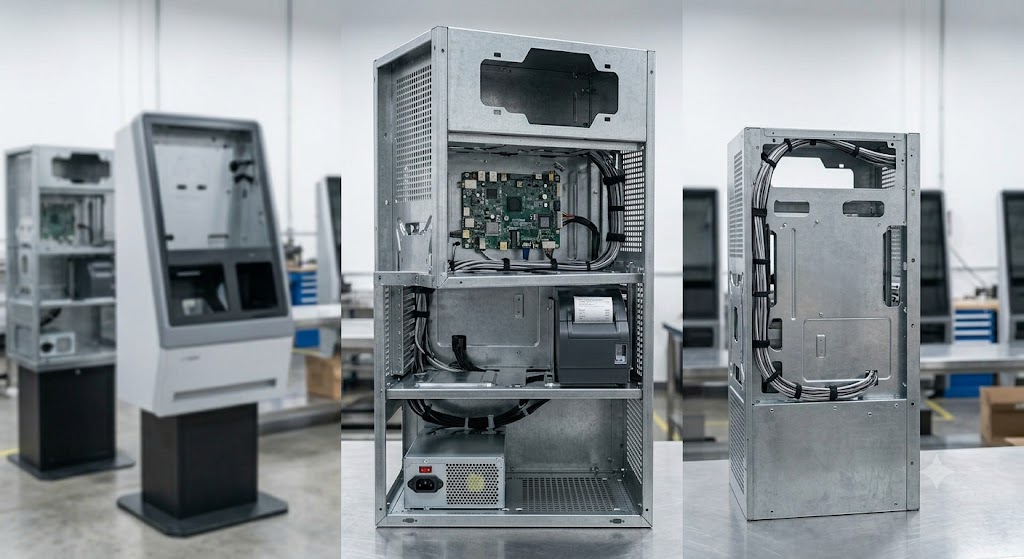
Fabricating a Self Service Machine Internal Chassis is vastly different from manufacturing a simple metal box or a standard electrical cabinet. These frames must securely and accurately house a multitude of sensitive and heavy components simultaneously. A typical kiosk chassis will hold heavy power supply units (PSUs), fragile LCD display screens, complex cable routing systems, coin hoppers, receipt printers, and moving dispensing mechanisms.
This creates a unique engineering challenge: cumulative tolerances. If a mounting hole on the base bracket is misaligned by even a fraction of a millimeter, that error compounds as you build upward. By the time you mount the touchscreen on the top tier, it might sit crooked against the outer shell. To prevent this, the fabrication partner must possess exceptional CNC forming capabilities and maintain strict adherence to ISO 2768-m tolerance standards across every single component.
Before the first cut is made, selecting the right material is crucial for the internal frame. Because this part of the machine is hidden from the user, aesthetic surface treatments (like high-gloss powder coating) are often unnecessary and add unjustified costs. Instead, engineers prioritize structural rigidity and inherent corrosion resistance.
For most internal chassis, Pre-Galvanized Steel (SECC or SGCC) is the undisputed champion. It offers the high tensile strength of cold-rolled steel but comes with a factory-applied zinc coating that prevents rust without the need for post-fabrication painting. In scenarios where weight reduction is critical—such as in wall-mounted medical terminals—aerospace-grade aluminum alloys (like 5052) are deployed, often finished with a clear anodizing layer to prevent oxidation and ensure electrical grounding.
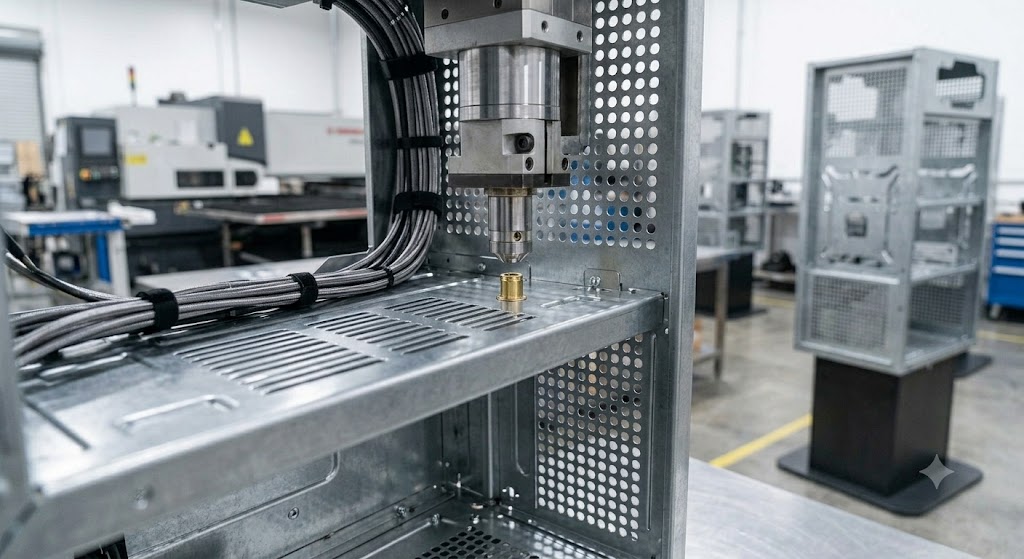
While high-powered laser cutting is excellent for slicing through thick exterior plates, CNC punching is the ultimate technology for fabricating internal frames. Internal chassis require massive arrays of functional features: ventilation holes for heat dissipation, specialized dimples for screw heads, bridge lances for cable zip-ties, and extruded tapped holes for hardware mounting.
Using an advanced CNC turret punch press (like our AMADA systems) allows manufacturers to stamp out hundreds of identical ventilation holes in seconds, while simultaneously forming 3D features that a laser simply cannot produce. This not only guarantees absolute consistency across large production runs but also significantly increases manufacturing efficiency, directly lowering the overall unit cost for our clients.
A major pain point for electronic equipment brands is the time and labor spent assembling the raw metal parts before the electronic wiring can even begin. Whether you are producing a complex medical diagnostic station or an OEM Vending Machine Metal Frame, turnkey mechanical assembly is a game-changer for your supply chain.
By partnering with a fully integrated OEM facility like HPS, the chassis arrives at your assembly line completely built. We utilize automated servo-presses to pre-install all PEM nuts, threaded standoffs, and captive fasteners with precise torque control. Furthermore, our assembly teams handle the installation of heavy-duty sliding rails, partition brackets, and hinges. This allows your in-house engineers to bypass mechanical assembly and focus entirely on what they do best: software integration, wiring, and final electronic testing.
Even the most brilliantly engineered 3D model can encounter issues on the factory floor. Before full-scale production begins, our engineering team conducts a comprehensive Design for Manufacturability (DFM) review. We look for opportunities to consolidate parts—perhaps bending a complex shape from a single sheet rather than welding three separate pieces together.
We analyze bend radii to prevent material cracking, ensure tool clearances for hardware insertion, and optimize the layout to minimize scrap material. This collaborative engineering approach ensures that your product is not only robust but also optimized for cost-effective mass production.
To ensure optimal performance and structural integrity, here are the standard parameters we apply to electromechanical frame fabrication:
| Fabrication Element | Specifications & Engineering Solutions |
|---|---|
| Optimal Materials | Pre-Galvanized Steel (SECC/SGCC) for cost-effective hidden anti-rust performance, Aluminum (5052) for weight reduction. |
| Forming Features | CNC punched cooling louvers, extruded tapped holes, cable-tie bridges, and countersinks. |
| Joining Methods | Precision Spot Welding, structural blind riveting, and bolt-on modular assembly for easy maintenance. |
| Hardware Integration | Automated, torque-tested insertion of PEM nuts, flush-head studs, and PCB standoffs. |
The reliability of an automated kiosk, ATM, or vending machine relies heavily on the precision of its internal chassis. By leveraging advanced CNC punching, rigorous tolerance control, deep DFM analysis, and turnkey hardware integration, equipment manufacturers can accelerate their time-to-market while ensuring their sensitive electronics are housed securely. Ready to optimize your next electromechanical project? Consult with the fabrication experts at Huapusheng today.
 Get a Quote Now


 IPv6 Network Supported
Leave A Message
Scan to Wechat :

Scan to Whatsapp :

Hi! Click one of our members below to chat on

 English
 Français
 Deutsch
 Русский
 Italiano
 Español
 Nederland
 日语
日语 한국어
한국어 Svenska