
For industrial equipment, electrical cabinets, control systems, telecom hardware, and battery-related equipment, enclosure weight can become a serious engineering issue. A heavier enclosure increases material consumption, shipping costs, installation effort, and sometimes the load placed on hinges, brackets, mounting structures, and supporting frames.
The obvious solution is to use thinner sheet metal. However, simply reducing material thickness can create new problems: panel deflection, vibration, oil-canning, distorted doors, weak mounting points, and poor resistance to impact. The better approach is to reduce weight through structural optimization rather than simply removing material.
For custom enclosures, the most effective lightweighting strategy usually combines material selection, formed geometry, ribs, flanges, bend optimization, localized reinforcement, and careful load-path analysis.
A common mistake is to select a sheet thickness first and then try to make the enclosure work around it. A better engineering process starts by identifying what the enclosure actually needs to withstand.
| Load or Requirement | Typical Design Concern | Lightweighting Approach |
|---|---|---|
| Equipment weight | Local panel deformation | Reinforce mounting zones |
| Door operation | Hinge-side deflection | Use formed flanges and local stiffeners |
| Vibration | Panel resonance and fatigue | Add ribs along critical load paths |
| Impact | Permanent denting | Use stronger material or localized reinforcement |
| Wall mounting | Fastener pull-out and panel bending | Strengthen mounting interfaces |
This distinction matters because not every part of an enclosure carries the same load. A large flat side panel may only need to resist its own weight and vibration, while a mounting bracket may carry several times the load of the surrounding sheet.
The most useful lightweighting principle in sheet metal fabrication is simple: shape can create stiffness without adding much mass.
A flat sheet has limited resistance to bending. When the same sheet is formed into a flange, channel, bead, rib, or return edge, its structural behavior changes significantly. The material is moved farther away from the neutral axis, increasing its resistance to bending.
This is why a properly designed 1.5 mm panel can sometimes perform better than a poorly designed 2.0 mm flat panel.
For example, one practical design reference describes replacing a 2.0 mm panel with a 1.5 mm ribbed panel, representing approximately 25% less sheet thickness while maintaining comparable rigidity in the specific design. The actual result depends on geometry, material, span, loading, and forming conditions, so this should be treated as a design target rather than a universal rule.
Large flat surfaces are usually the first place to look for weight reduction. Simply making them thinner can cause visible flexing or “oil-canning.” A better solution is to introduce formed ribs or embossments.
Ribs work by increasing the effective structural depth of the panel. They are particularly useful on enclosure doors, removable covers, side panels, and long equipment housings.
| Design Option | Weight | Panel Stiffness | Manufacturing Complexity |
|---|---|---|---|
| Thick flat sheet | High | Medium | Low |
| Thin flat sheet | Low | Low | Low |
| Thin sheet + ribs | Low | High | Medium |
| Thin sheet + welded reinforcement | Medium | High | High |
The important point is rib placement. A rib should follow the expected load path rather than being added simply for appearance. Long unsupported spans, hinge areas, mounting zones, and locations around heavy components are usually better candidates for reinforcement.
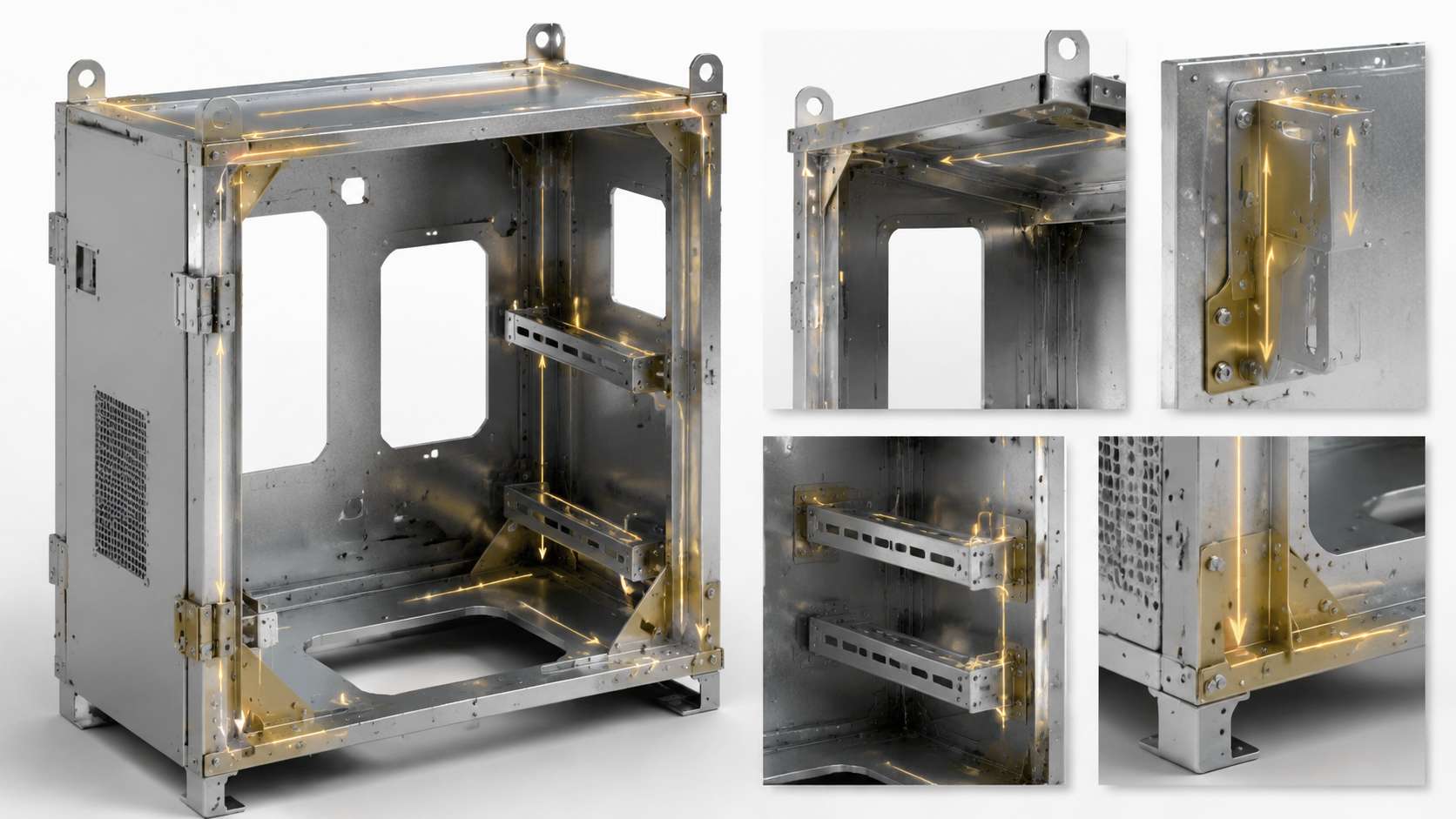
Flanges are another low-cost way to increase stiffness. Instead of leaving a panel edge flat, bending the edge creates a return that behaves like a small structural beam.
This is especially effective around enclosure doors and covers. A properly sized return flange can reduce edge deformation while also providing a useful surface for seals, fasteners, hinges, or adjacent panels.
For a Custom Sheet Metal Enclosure, the designer should therefore consider the complete folded geometry rather than evaluating each flat panel separately.
In many cases, several bends can perform the work that would otherwise require welded reinforcement. This can reduce part count, welding operations, distortion risk, and secondary finishing work at the same time.
Material substitution can produce a larger weight reduction than simply changing gauge. Aluminum, for example, has a much lower density than steel and can be attractive when weight, corrosion resistance, and thermal performance are important.
| Material | Approx. Density | Common Advantage | Potential Limitation |
|---|---|---|---|
| Mild steel | ~7.85 g/cm³ | Cost-effective and strong | Higher mass |
| Aluminum | ~2.7 g/cm³ | Low density and corrosion resistance | Lower modulus than steel |
| Stainless steel | ~7.9–8.0 g/cm³ | Corrosion resistance and durability | Higher cost and weight |
Density alone should not determine the material. For example, aluminum's lower elastic modulus means that a direct thickness-for-thickness substitution does not automatically produce the same stiffness. Geometry, alloy, temper, joining method, and expected loading all need to be considered.
One of the easiest ways to add unnecessary weight is to reinforce an entire enclosure when only a few locations actually require additional strength.
A more efficient approach is localized reinforcement.
This approach allows the main enclosure panels to remain relatively light while maintaining strength at critical interfaces.
Weight reduction often involves ventilation openings, cable entries, display cutouts, or access holes. However, removing material from a panel can significantly change its stiffness.
A large rectangular cutout in the center of a panel may create a weak zone around the opening. Rounded corners, edge returns, local flanges, or reinforcement frames can help recover some of the lost rigidity.
Bend design also matters. Sheet metal cannot be treated like a sharp-cornered solid block. The actual bend radius depends on material, thickness, tooling, and forming method. Tight internal radii can increase the risk of cracking, distortion, or dimensional variation.
For a Lightweight Fabricated Metal Enclosure, the best design is therefore one that considers cutting and bending together rather than optimizing the flat pattern alone.
A theoretically lightweight design may become expensive if it requires too many special operations. Before releasing a design, review the manufacturing route with the fabricator.
| Optimization | Possible Weight Benefit | Manufacturing Check |
|---|---|---|
| Reduce sheet thickness | High | Deflection, forming and handling |
| Add formed ribs | Medium–High | Tooling and forming depth |
| Use return flanges | Medium | Bend sequence and interference |
| Change material | High | Cost, welding, finish and availability |
| Localized reinforcement | Medium | Assembly and joining method |
When an enclosure has strict weight limits or carries expensive equipment, engineering judgment alone may not be enough. Finite element analysis (FEA) can help identify where material is actually contributing to structural performance.
A practical workflow is:
The goal is not to make every panel as thin as possible. The goal is to place material where it contributes to stiffness, strength, impact resistance, or mounting reliability.
For many enclosure projects, a sensible optimization sequence is to first eliminate unnecessary material, then improve geometry, and only afterward consider more complex manufacturing solutions.
A useful engineering review can follow this order:
| Step | Question to Ask |
|---|---|
| 1 | Which panels are carrying real structural loads? |
| 2 | Can flat surfaces be stiffened with ribs or formed features? |
| 3 | Can flanges replace some welded reinforcement? |
| 4 | Can reinforcement be limited to mounting and high-load zones? |
| 5 | Would another material provide a better strength-to-weight balance? |
| 6 | Can the optimized design still be laser cut, bent, welded and finished efficiently? |
| 7 | Has the final design been validated through simulation or physical testing? |
Successful enclosure lightweighting is not simply a matter of choosing thinner sheet metal. The better strategy is to understand the load path and use geometry to make each gram of material work harder.
Ribs can stiffen large panels. Flanges can turn thin edges into structural members. Local reinforcement can protect high-load interfaces without adding weight everywhere. Material selection can further reduce mass when the application allows it.
For manufacturers developing a Industrial Sheet Metal Enclosure, these decisions should be made before fabrication rather than after a heavy prototype has already been produced. Early collaboration between the design engineer and fabrication supplier can also identify bend-radius, tooling, welding, tolerance, and assembly issues before they become production problems.
The strongest lightweight enclosure is rarely the one with the most material. It is the one where material, geometry, manufacturing process, and load requirements have been designed as one system.
```
 Get a Quote Now


 IPv6 Network Supported
Leave A Message
Scan to Wechat :

Scan to Whatsapp :

Hi! Click one of our members below to chat on

 English
 Français
 Deutsch
 Русский
 Italiano
 Español
 Nederland
 日语
日语 한국어
한국어 Svenska