
For decades, sheet metal fabrication was viewed as a highly manual, labor-intensive industry relying heavily on the physical craftsmanship of operators. From manually setting up press brakes to spending hours in noisy grinding rooms smoothing out laser slag, the traditional job shop was limited by human constraints. Today, that landscape is undergoing a seismic shift.
The integration of Artificial Intelligence (AI) and advanced automation—often referred to as Industry 4.0 or the "Smart Factory"—is completely redefining how Custom Sheet Metal Kiosk Chassis, server racks, medical device enclosures, and industrial components are produced. From intelligent algorithms that minimize material waste to robotic arms that fold heavy carbon steel with millimeter precision, technology is driving unprecedented levels of efficiency, scalability, and zero-defect quality. Let’s deeply explore exactly how AI and automation are changing the sheet metal manufacturing industry and what it means for your supply chain.
Before a single piece of metal is even loaded onto a cutting bed, AI is already saving manufacturers and their clients money. Traditional CAD/CAM nesting required engineers to manually arrange flat patterns on a sheet to minimize scrap. This process was incredibly time-consuming, relied heavily on the engineer's experience, and often left significant usable material on the table.
Modern AI-driven nesting algorithms have revolutionized material planning. These software systems can analyze hundreds of complex, mixed-part geometries in seconds, calculating the absolute optimal arrangement on raw sheets. By factoring in grain direction, thermal distortion during cutting, and shared cutting lines (common-line cutting), these intelligent systems push material utilization rates beyond 90%. Furthermore, when a rush order comes in, the AI can dynamically re-nest the daily production schedule on the fly, directly reducing the raw material costs passed down to the OEM customer.
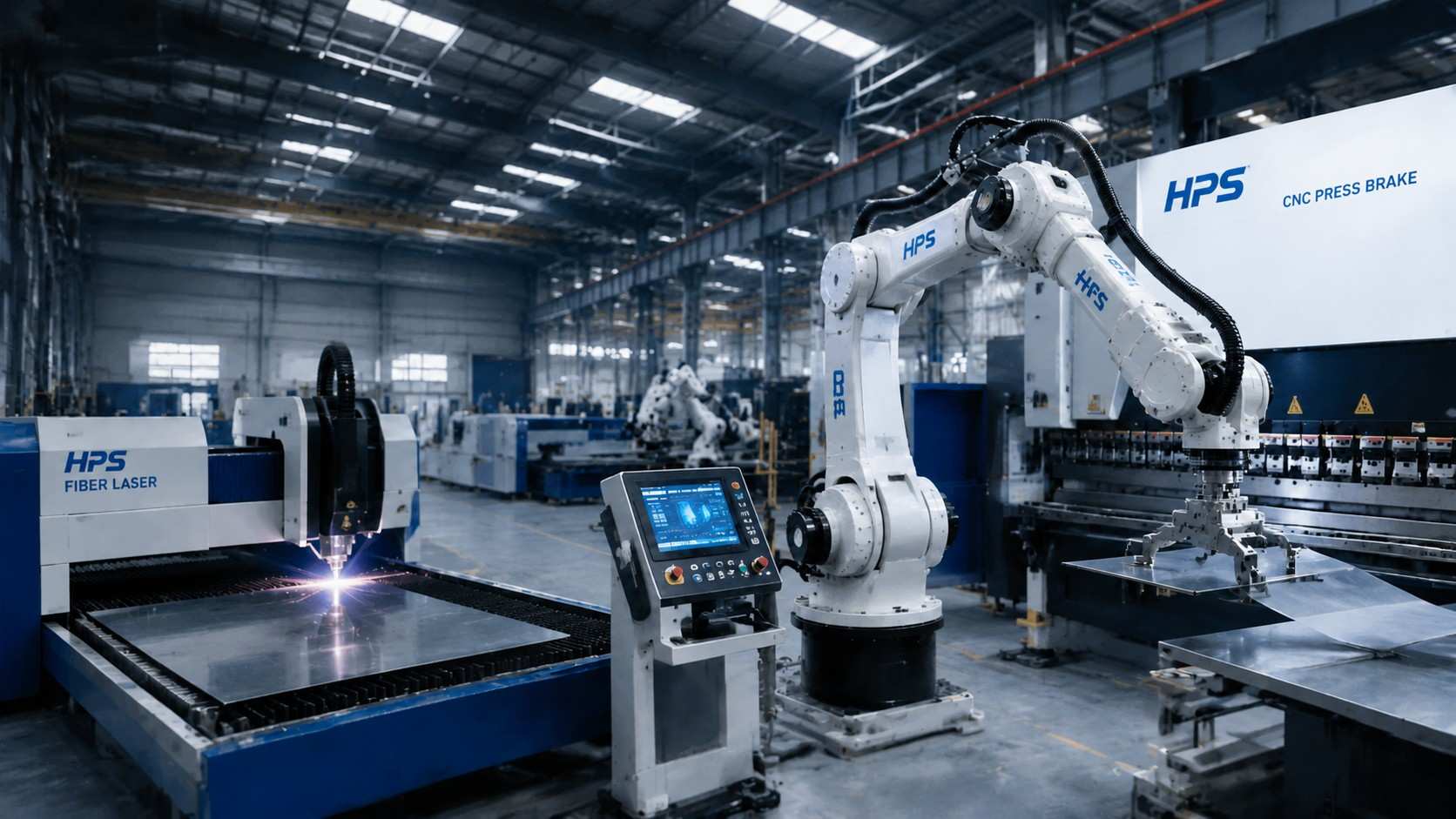
Laser cutting has always been fast, but the introduction of high-power fiber lasers (e.g., 12KW to 20KW) paired with machine learning has pushed the boundaries of reliability. In the past, cutting thick carbon steel or reflective aluminum could result in blowouts, excessive slag, or nozzle damage if the operator didn't monitor the machine constantly.
Today's automated laser cutting centers feature AI-powered cutting heads. These optical systems monitor the pierce process and the melt pool in real time. If the AI detects a potential cutting failure, it instantly adjusts the laser power, gas pressure, and cutting speed without human intervention. Additionally, automated material handling towers load raw sheets and unload finished skeletons 24/7, enabling true "lights-out" manufacturing.
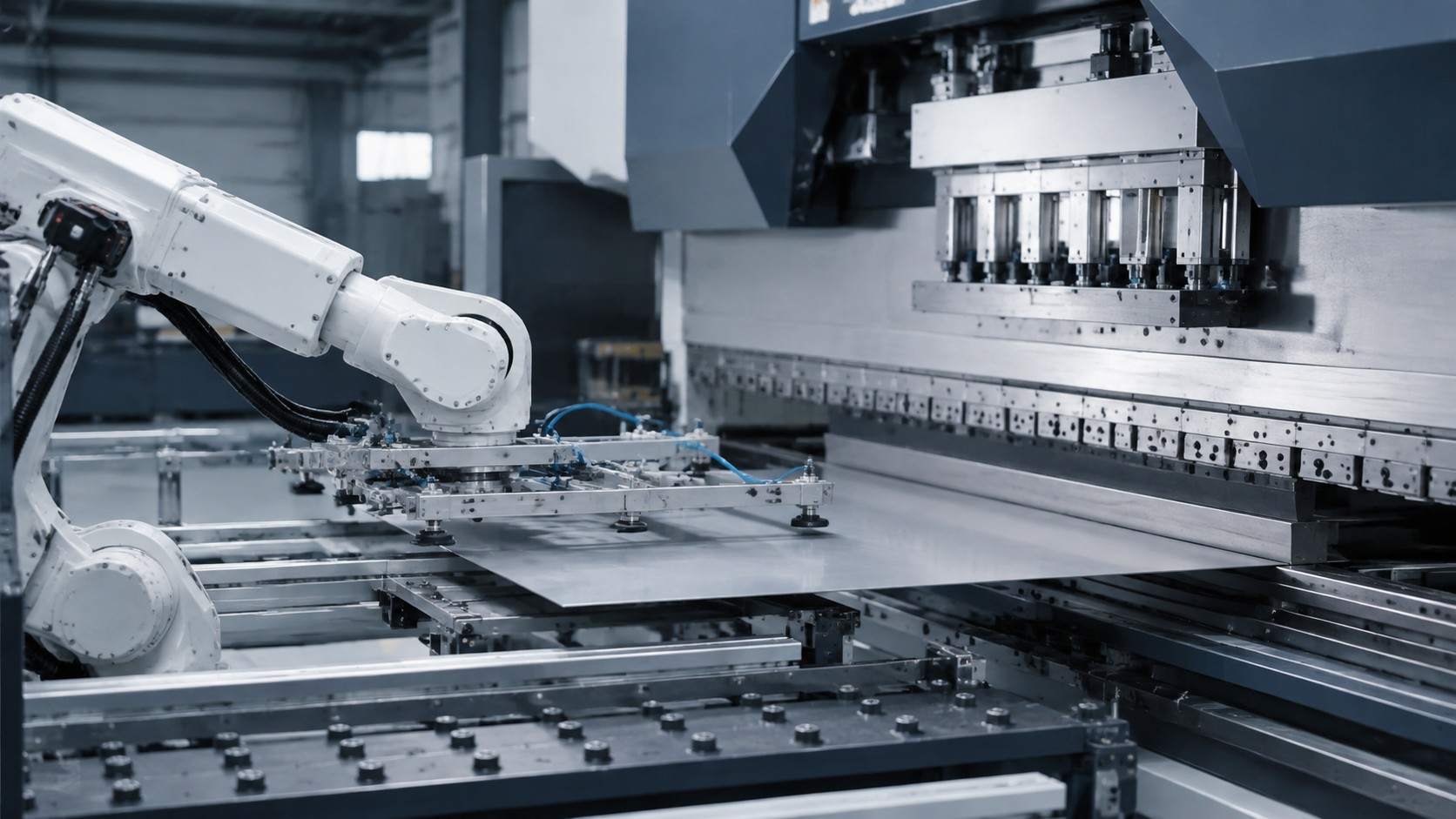
Bending large, heavy sheet metal panels on a traditional press brake is physically exhausting and dangerous. As an operator fatigues throughout their shift, the risk of misalignment and inaccurate bend angles increases dramatically. Furthermore, setting up the press brake with the correct upper and lower dies for high-mix, low-volume (HMLV) jobs takes up valuable production time.
Automated bending robots and Automatic Tool Changers (ATC) have solved these bottlenecks. Synchronized with CNC press brakes, 6-axis robotic arms can effortlessly lift and manipulate massive metal sheets with pinpoint precision. Because robots do not suffer from fatigue, the 500th bend is mathematically identical to the first. Meanwhile, the ATC system automatically swaps out the bending dies in a matter of seconds between jobs, drastically reducing setup time and ensuring perfect repeatability for complex components like Precision Sheet Metal Mounting Brackets.
Historically, deburring and edge rounding were the most notorious bottlenecks in fabrication. Manual angle grinding was inconsistent, slow, and created hazardous work environments filled with metallic dust and noise.
Today, fully Automatic Sheet Metal Deburring Machines process laser-cut parts in seconds. By utilizing variable frequency drives (VFD) and multi-directional abrasive brush systems, these machines consistently remove hardened laser dross, eliminate micro-burrs, and create perfect R-angles. This automated consistency is not just about aesthetics; it is crucial for ensuring flawless powder coating adhesion and eliminating field failures caused by the "edge effect" (where paint peels away from sharp corners, leading to rust).
Quality control is no longer just a final inspection done with calipers at the shipping dock. AI-powered machine vision systems and 3D scanners are now integrated directly into the production lines. These cameras monitor robotic weld pools in real-time, instantly adjusting parameters if a defect like porosity is predicted.
Furthermore, finished components can be scanned using high-resolution 3D optical trackers (accurate to 0.03mm) and instantly overlaid against the client's original 3D CAD file. The software automatically highlights any dimensional deviations in a color-coded heat map, ensuring that every hole, slot, and welded flange meets strict ISO tolerances before assembly.
AI and automation are doing much more than just speeding up production; they are fundamentally elevating the quality, consistency, and cost-effectiveness of custom metal fabrication. By removing human error from critical operations like nesting, laser cutting, bending, and deburring, smart factories provide OEM clients with unparalleled supply chain reliability.
If your current fabrication partner is still relying entirely on manual processes, you may be paying for their inefficiencies and risking product quality. By partnering with a forward-thinking facility equipped with advanced robotic forming, automated finishing, and smart QA systems, you ensure your products are built for the demands of the modern market. Ready to experience the benefits of automated manufacturing? Contact our engineering team today to review your next project.
 Get a Quote Now


 IPv6 Network Supported
Leave A Message
Scan to Wechat :

Scan to Whatsapp :

Hi! Click one of our members below to chat on

 English
 Français
 Deutsch
 Русский
 Italiano
 Español
 Nederland
 日语
日语 한국어
한국어 Svenska