
In the world of industrial manufacturing, the gap between a design file and a finished product is often filled with unforeseen engineering challenges. For procurement managers and product engineers, the primary concern isn't just finding a vendor who can cut metal; it is finding a partner who understands how strict tolerances and material selection impact the lifecycle of the final product.
Whether you are deploying high-voltage switchgear in a factory or installing energy storage systems in a coastal desert, the integrity of your hardware relies entirely on the precision of the manufacturing process.
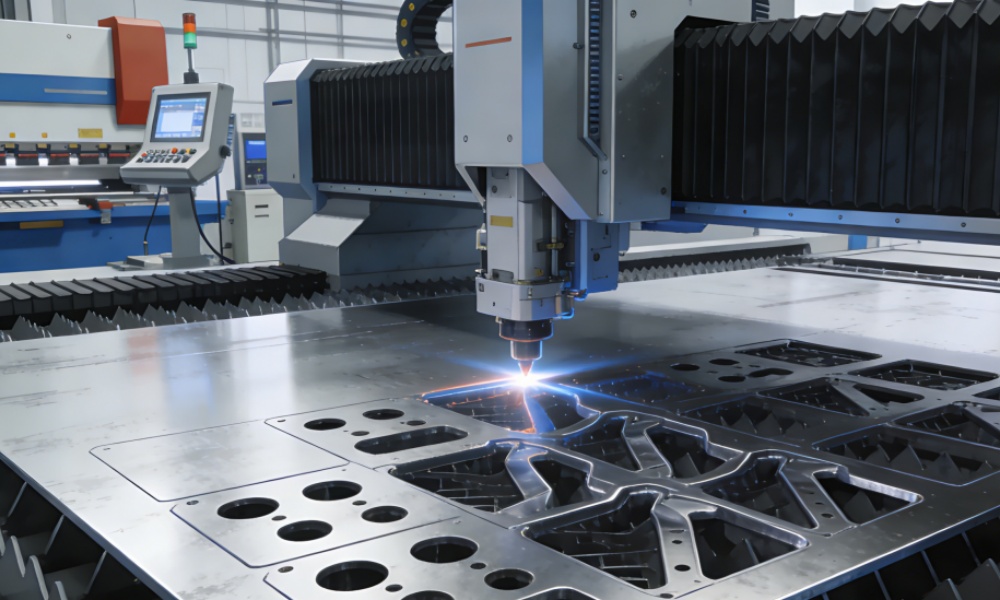
One of the most frequent issues in Sheet Metal Enclosure Fabrication is the mismanagement of tolerance stack-up. On a single part, a deviation of +/- 0.2mm might seem negligible. However, when assembling a multi-part server rack or a modular control cabinet, these deviations accumulate.
If a vendor does not strictly adhere to ISO 2768-m (or tighter) standards, the downstream effects are costly:
Increased Assembly Time: Technicians waste hours filing down edges or forcing holes to align.
Compromised IP Rating: Gaps in the welding or bending seams allow moisture ingress, fatal for outdoor electronics.
Thermal Inefficiency: Poor contact between the chassis and heat sinks reduces dissipation efficiency.
Below is a comparison of standard versus precision fabrication tolerances and their impact on assembly efficiency:
| Tolerance Standard | Typical Application | Fabrication Method | Assembly Impact |
| +/- 0.5 mm | General brackets, simple boxes | Plasma / Standard Punching | High risk of misalignment in complex assemblies. |
| +/- 0.1 mm | Custom Sheet Metal Chassis | Laser Cutting / CNC Bending | Seamless fit; reduces assembly labor by ~30%. |
| +/- 0.05 mm | Aerospace / Medical Enclosures | High-Precision Laser / Machining | Perfect interchangeability; zero rework required. |
Achieving the +/- 0.1mm standard required for a high-density Custom Sheet Metal Chassis demands automated bending centers equipped with angle measurement systems. These systems automatically correct the spring-back of the metal in real-time, ensuring that a 90-degree bend is exactly 90 degrees, regardless of material batch variations.
When moving from indoor electronics to Outdoor Battery Enclosures, the engineering requirements shift drastically from "fit" to "survival." Energy storage systems are often deployed in harsh environments—remote solar farms, EV charging stations, or industrial zones with high pollution.
The choice of material determines whether an enclosure lasts 2 years or 20 years. Many projects fail because the specification called for "Standard Carbon Steel" without considering the specific environmental corrosivity category (C3, C4, or C5).
Comparative Data on Corrosion Resistance:
Electro-Galvanized Steel (SECC): Suitable for indoor use. If used outdoors, even with powder coating, edge corrosion typically begins within 24-36 months in humid climates.
Aluminum 5052/6061: Excellent strength-to-weight ratio. Naturally forms a protective oxide layer. Ideal for heat dissipation but requires careful welding to avoid cracking.
Stainless Steel 304/316L: The gold standard for Outdoor Battery Enclosures. While the raw material cost is 3-4x higher than carbon steel, the maintenance cost over a 10-year period is near zero.
We recommend the following material-finish combinations based on the installation environment:
| Environment | Recommended Material | Surface Treatment | Expected Lifespan |
| Indoor / Climate Controlled | Cold Rolled Steel (SPCC) | Powder Coating (60-80μm) | 15+ Years |
| Outdoor / Urban | Zintec / Galvanized Steel | Zinc Primer + Polyester Powder | 10-15 Years |
| Outdoor / Coastal (High Salinity) | Stainless Steel 316L | Passivation / Brushed | 20+ Years |
For items like the precision high-voltage cable boxes or the airtight air chamber boxes shown in our portfolio, traditional manual welding is often insufficient. Manual welding introduces inconsistent heat zones, which leads to warping—a nightmare for maintaining the flatness required for Custom Sheet Metal Chassis backplanes.
Modern Sheet Metal Enclosure Fabrication utilizes robotic laser welding. This technology offers distinct advantages for high-value components:
Low Heat Input: Laser welding creates a narrow heat-affected zone (HAZ), minimizing thermal distortion. This is crucial when welding thin-gauge stainless steel (1.0mm - 1.5mm).
Hermetic Seals: For battery boxes requiring IP66 or IP67 ratings, continuous laser welding provides a uniform, non-porous seam that prevents water and dust intrusion without the need for excessive silicone sealants.
Aesthetics: The weld bead is smooth and requires minimal grinding, preserving the surface coating's integrity.
A frequently overlooked aspect of fabrication is how the manufacturing method supports thermal management. A Custom Sheet Metal Chassis often houses heat-generating components like power supplies, CPUs, or inverters.
Fabricators must be capable of producing complex ventilation patterns without deforming the sheet. Using a turret punch press with cluster tools allows for high-density hexagonal perforation patterns (which offer 60% open area for airflow) while maintaining structural rigidity. Laser cutting, while precise, can be too slow for thousands of small holes. Therefore, a hybrid approach—punching for ventilation and laser for contours—is often the most cost-effective solution for high-volume chassis production.
Trusting a manufacturer requires visibility into their Quality Assurance (QA) protocols. A dimensionally correct part that fails coating adhesion tests is still a failed part.
For Outdoor Battery Enclosures, the critical quality check is the Salt Spray Test (ASTM B117). A reliable manufacturer should perform this in-house or via third-party labs.
Standard QC Protocol for Industrial Enclosures:
Incoming Material Check: Verifying thickness and chemical composition.
First Article Inspection (FAI): CMM (Coordinate Measuring Machine) verification of all critical dimensions and hole positions.
Process Inspection: Real-time monitoring of bending angles and weld penetration.
Finish Testing:
Cost reduction should come from design optimization (DFM), not from cutting corners on materials. For instance, replacing welding with riveting in non-structural areas can reduce labor costs by 20%. Similarly, designing parts that can be nested efficiently on a raw metal sheet reduces scrap rates.
When you engage with a fabrication partner, ask for a DFM report before production begins. A proactive review can identify features that drive up costs unnecessarily—such as deep narrow slots, non-standard hole sizes, or impossible bend radii—allowing you to modify the design for cheaper, faster production.
 Get a Quote Now


 IPv6 Network Supported
Leave A Message
Scan to Wechat :

Scan to Whatsapp :

Hi! Click one of our members below to chat on

 English
 Français
 Deutsch
 Русский
 Italiano
 Español
 Nederland
 日语
日语 한국어
한국어 Svenska