
As component densities in industrial automation and energy storage increase, the physical enclosure housing these systems transforms from a simple protective shell into an active thermal management device. Equipment failure is rarely instantaneous; it is typically the result of prolonged exposure to operating temperatures exceeding the manufacturer's specified limits. Designing a system that effectively dissipates heat requires precise material selection, calculated perforation ratios, and an understanding of thermodynamic behavior within confined metallic spaces.
This document outlines the engineering variables required to calculate and manage thermal loads in custom fabricated hardware, moving beyond basic ventilation into calculated thermodynamic control.
The primary mechanism for passive cooling in a sealed, unventilated enclosure is conduction through the metal walls, followed by natural convection and radiation from the external surface. The chosen alloy dictates the efficiency of this transfer. While thermal conductivity measures how fast heat travels through the material thickness, emissivity measures how effectively the surface radiates heat away.
Mild steel (SPCC) and Aluminum (AL5052/AL6061) behave very differently under thermal load. Aluminum conducts heat roughly four times faster than carbon steel, acting as an excellent heat sink. However, bare shiny aluminum has a very low emissivity rating, meaning it struggles to radiate that heat into the surrounding air. To optimize aluminum for thermal dissipation, it must be anodized or powder-coated, which drastically increases its emissivity factor.
| Material Grade | Thermal Conductivity (W/m·K) | Emissivity (Bare) | Emissivity (Powder Coated / Anodized) |
|---|---|---|---|
| Carbon Steel (SPCC) | 45.0 | 0.20 - 0.30 | 0.85 - 0.92 |
| Aluminum (5052-H32) | 138.0 | 0.04 - 0.09 | 0.82 - 0.86 (Anodized) |
| Stainless Steel (304) | 16.2 | 0.15 - 0.25 | 0.85 - 0.90 |
| Galvanized Steel (SGCC) | 40.0 | 0.28 | 0.85 - 0.90 |
For sealed enclosures deployed in high-heat outdoor environments, calculating the exact surface area required to dissipate the internal wattage is necessary. The general formula for temperature rise in a sealed enclosure is ΔT = P / (k × A), where P is the internal power dissipation in Watts, A is the exposed surface area in square meters, and k is a constant representing the heat transfer coefficient (typically 5-6 W/m²K for free convection in air).
When internal heat generation exceeds the capacity of passive surface radiation, forced air convection via cooling fans becomes mandatory. In these scenarios, the physical geometry of the ventilation cutouts dictates the efficiency of the fans. A common engineering error is failing to match the open area ratio of the sheet metal with the required CFM (Cubic Feet per Minute) of the cooling system.
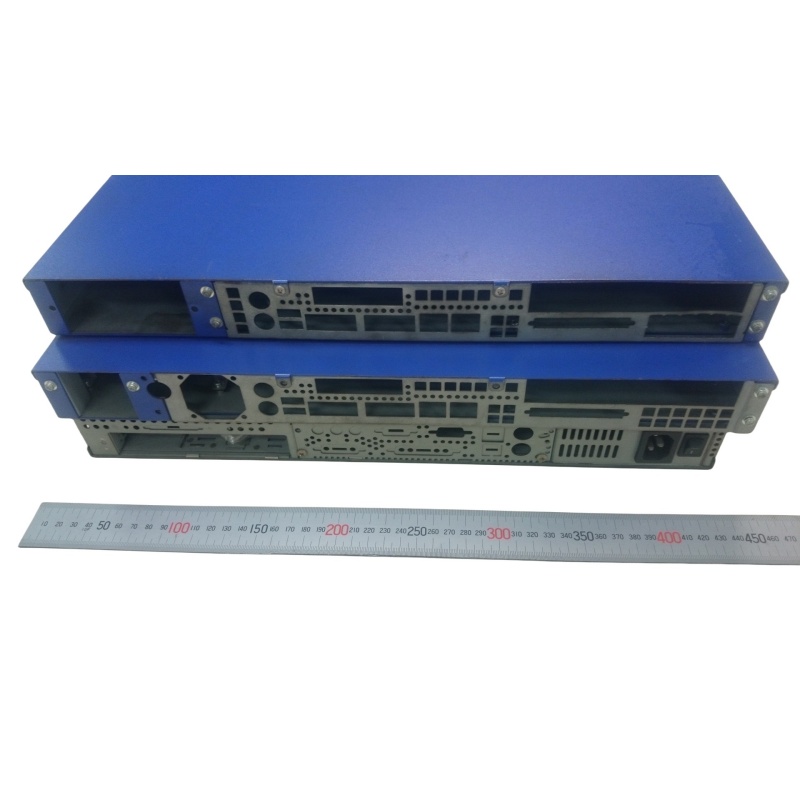
When specifying a Custom Sheet Metal Rackmount Chassis for IT or telecom applications, the front and rear door perforation patterns act as a severe bottleneck if not calculated correctly. Standard round holes stacked in a square grid rarely exceed a 45% open area. To accommodate high-velocity server fans, fabricators must utilize a staggered hexagonal punching pattern. The hexagonal geometry leaves the minimal amount of metal webbing between holes while maintaining structural rigidity, pushing the open area ratio closer to 63-70%.
| Punching Geometry | Arrangement | Maximum Open Area (%) | Airflow Resistance |
|---|---|---|---|
| Round Hole (5.0mm) | Square Grid | 40% - 45% | High (Causes turbulence) |
| Round Hole (5.0mm) | 60° Staggered | 50% - 58% | Moderate |
| Hexagonal (6.35mm) | Staggered Nesting | 63% - 72% | Low (Optimal for servers) |
| Slotted Rectangular | Parallel | 35% - 40% | Very High (High static pressure) |
Airflow resistance causes static pressure to build up inside the enclosure. If the static pressure exceeds the operating curve of the axial fans, airflow drops significantly, and a thermal runaway event can occur within minutes. Engineers must calculate the total required CFM using the formula: CFM = (Q × 3.16) / ΔT, where Q is the total heat generated in Watts, and ΔT is the maximum allowable temperature rise in degrees Fahrenheit.
Thermal dynamics shift significantly when designing for chemical energy storage, particularly in outdoor environments. A Heavy Duty Sheet Metal Battery Box must account for both internal discharge heat (Joule heating from the cells) and external ambient solar radiation. Lithium-ion modules are highly sensitive to thermal gradients; if the cells at the top of the enclosure operate 5°C hotter than the cells at the bottom, battery degradation accelerates rapidly, and the total system lifespan is compromised.
To combat thermal stratification, the internal sheet metal architecture requires precisely engineered baffling. Instead of simply mounting batteries to a flat backplate, fabricators use CNC-folded internal partitions to channel cool air directly across the heat sinks of the battery management system (BMS) before it reaches the cell modules. Furthermore, outdoor systems utilize a double-wall construction method. A secondary external metal skin acts as a solar shield, allowing a 15mm to 25mm air gap between the outer skin and the primary enclosure wall. As the outer skin heats up from the sun, the air in the gap rises naturally via the stack effect, pulling cool air from the bottom and actively rejecting solar thermal load before it penetrates the internal compartment.
Heat does not merely damage electronic components; it physically alters the dimensions of the metal housing. The Coefficient of Thermal Expansion (CTE) defines how much a material will stretch as it heats up. While a few millimeters of expansion may seem negligible, it creates severe mechanical stress in tightly toleranced assemblies.
When operating at sustained internal temperatures above 65°C, a Custom Industrial Equipment Cabinet Frame undergoes significant thermal expansion. If the structural uprights are manufactured from aluminum (CTE: 23.6 µm/m·°C) and the internal mounting rails are made of carbon steel (CTE: 12.0 µm/m·°C), the two metals will expand at completely different rates. Over a two-meter vertical span, this differential expansion can shear rivets, bind door hinges, and warp internal DIN rails out of alignment. To mitigate this, structural engineers utilize slotted mounting holes with floating fastener assemblies (such as PTFE washers or captive spring nuts) where different alloys intersect, allowing the metal to expand and contract freely along a single axis without compromising the structural integrity of the frame.
 Get a Quote Now


 IPv6 Network Supported
Leave A Message
Scan to Wechat :

Scan to Whatsapp :

Hi! Click one of our members below to chat on

 English
 Français
 Deutsch
 Русский
 Italiano
 Español
 Nederland
 日语
日语 한국어
한국어 Svenska